The Higher Self and the Ego
Silence as an answer
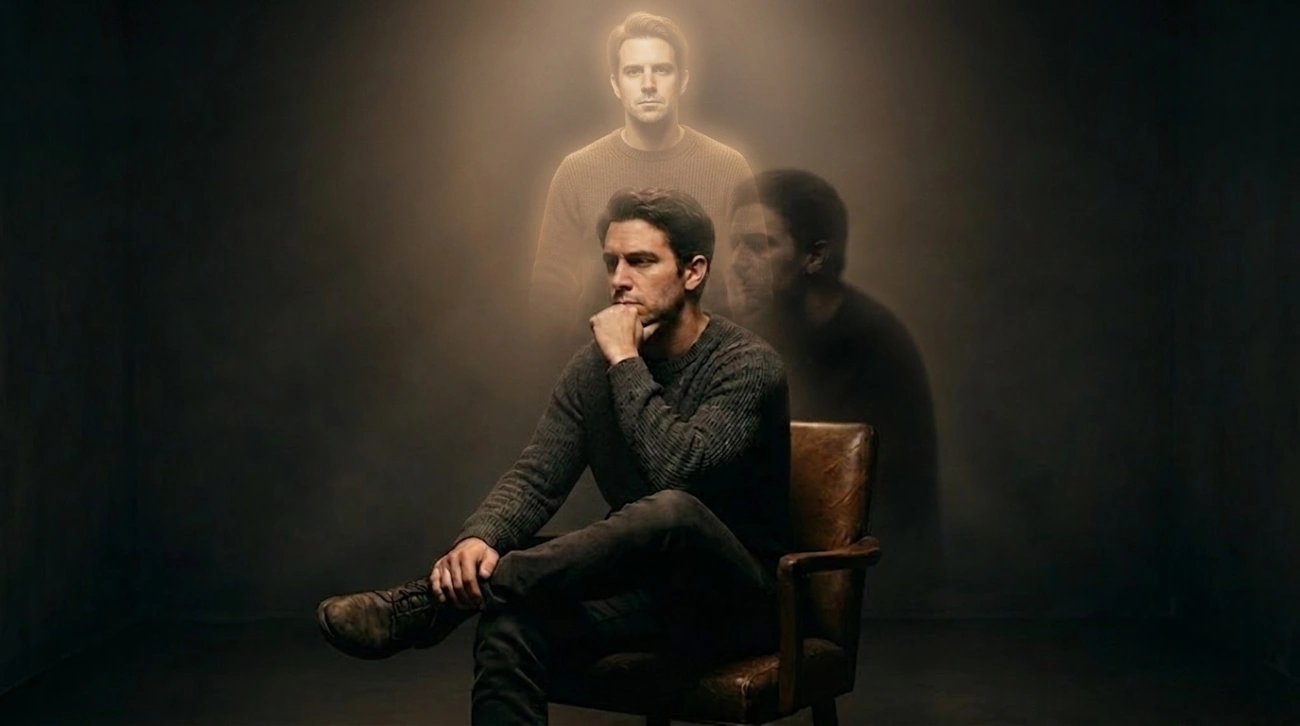
Everyone knows when their higher self is speaking. You recognize it by the calm, by the clarity, by that inner voice that appears in moments of stillness and tells you exactly what you need to hear. And you recognize the ego too. It’s the one that sabotages you, the one that’s afraid, the one that pulls you toward what’s not good for you.
Two characters. Perfectly defined. Perfectly identifiable.
Now stop. Define the higher self in one sentence. No pretty words. No “energy”, no “vibration”, no “connection with something greater”. A concrete sentence that explains what it is, where it lives and how it works.
The silence that follows that question is, probably, the most honest answer you’re going to find.
* * *
One, not two
Strip away the labels and what’s left is considerably less glamorous than two entities at war. A personality that moves, that changes, that reacts differently depending on the day, on how much you slept, on whether you just got good news or bad. Sometimes it makes decisions from fear. Other times from clarity. Sometimes it knows exactly what it wants. Other times it’s been clueless for three weeks.
There aren’t two selves there. There’s one that expresses itself differently depending on the waves that come in. And depending on the direction it takes at any given moment, we give it different names, as if they were separate things. But the one moving in all those directions is the same.
This isn’t a new idea. People have been saying it for a long time, in different languages, pointing at the same thing.
* * *
What we’re actually talking about
When serious traditions speak of that part of the self connected to something greater, they’re not talking about a voice that helps you decide whether to send that text or not. They’re talking about something of a different order. The core of the spirit. The essence. What Vedanta calls Atman. What Sufism places at the highest level of the nafs after years of real work. Something that can’t be summoned at will, that doesn’t appear just because you’ve reached a state of calm, and that when it does manifest, it doesn’t come to comment on your career.
That exists and it has weight. And it requires very specific conditions to even get close to it.
What circulates as the higher self in consumer spirituality is something else entirely: an internal consultant available twenty-four hours a day, specialized in everyday decisions, always right, and who curiously never says anything you don’t want to hear. Same label, completely different content. Like buying orange-flavored water and having the bottle say juice.
* * *
What those who’d actually been there said
Sufism describes seven levels of the nafs, which you could translate as the self or the soul depending on how you look at it. Not two. Seven. From the tyrannical self, the most primitive, the one that only thinks about its own desires, to the pure self, the one closest to the divine. And spiritual work consists of moving through those levels with real discipline, not identifying which of two characters is speaking right now.
Hindu Vedanta speaks of Viveka, the capacity to discriminate between the real and the unreal, between the permanent and the impermanent. But it’s not a feeling of inner peace that shows up when you meditate for twenty minutes. It’s a rigorous mental training that can take years under the guidance of someone who actually knows what they’re doing.
Buddhism goes further than all of them and flat-out denies that any permanent self exists. There’s no higher self because there’s no fixed self. What there is, is a continuum of experiences with no stable owner behind them.
And Native Americans have the story of the two wolves: one good and one evil, and the one that wins is the one you feed. Simpler, more direct, equally valid.
Four traditions, four different vocabularies. None of them divide into two boxes.
They all talk about a process, about something that’s worked at, about nuances worth knowing. The problem comes when someone takes those nuances, strips them of context, and turns them into two named characters living inside you who take turns speaking.
* * *
The grinder
At some point in the last century, all that complexity went through a grinder and came out in two clean pieces.
Higher self: the good part. The divine part. The one connected to something greater, the one that’s never wrong, the one that appears in moments of stillness and whispers eternal truths. The part of you worth keeping.
Ego: the rest. The fallen part. The bin where everything inconvenient goes, everything that doesn’t fit the image you have of yourself, everything you’d rather not acknowledge. The part of you not worth keeping.
If this sounds familiar it’s because it is. It’s exactly the same structure that’s been circulating in Western religious tradition for centuries: a pure part, connected to the divine, and a contaminated, fallen part that needs to be watched and controlled. Original sin in new clothes. The battle between soul and flesh translated into self-help language.
Nobody says it like that, of course. Nobody uses those words. But the architecture is identical. You’ve been inside it so long you can no longer see the walls.
* * *
The third box
The system has two boxes. Reality has three.
The part that acts well. The part that acts badly. And the part that’s staring at the ceiling not knowing what to have for dinner, whether to call that person or not, whether the current job has a future, whether what it’s feeling is intuition or anxiety or just hunger.
That third part has no box. It’s not luminous enough to be the higher self and not dark enough to be the ego. It’s simply someone who doesn’t know, who doubts, who feels their way along. Which is, if we’re honest, where most people live most of the time.
The system has no answer for that. When you’re in that grey zone of not knowing, of being lost without drama, of functioning without any special clarity or visible self-sabotage, the vocabulary of higher self and ego runs out of argument. There’s no character to slot in. No villain, no hero.
And yet there you are. No box.
* * *
Who spoke?
People say they know when it’s the higher self because it feels different. Calmer. Clearer. A voice that doesn’t insist, that has no urgency, that simply appears and points. The ego, on the other hand, is anxious, reactive, loud, insistent.
You make a decision. It goes well. That was the higher self. You make another decision. It goes badly. That was the ego. The higher self is never wrong because any mistake gets automatically reassigned to the other box. It’s a system that never loses because it changes the rules after every move.
And then there’s the question nobody wants to answer: when you really screw up, when you make the worst possible decision with complete calm and clarity, who spoke? Because there were moments of stillness there too. There was a voice pointing. There was certainty.
Was the higher self on holiday that day? Did it have another meeting?
The criterion doesn’t distinguish anything. It only confirms what you’d already decided to believe.
* * *
There are no two characters at war. There’s one that sometimes gets caught in the whirlwind and sometimes manages to step out of it.
The techniques for reaching that state of clarity exist and they work. What doesn’t work is the story that comes with the name: that that state is your true self, that the noise is the enemy, that one is worth keeping and the other isn’t. Stepping out of the whirlwind doesn’t turn you into a different person. It gives you perspective. Which is not the same thing.
The work is yours. Not the good character’s you carry inside.
It’s simpler than it seems. And considerably more uncomfortable.