Angels and Demons
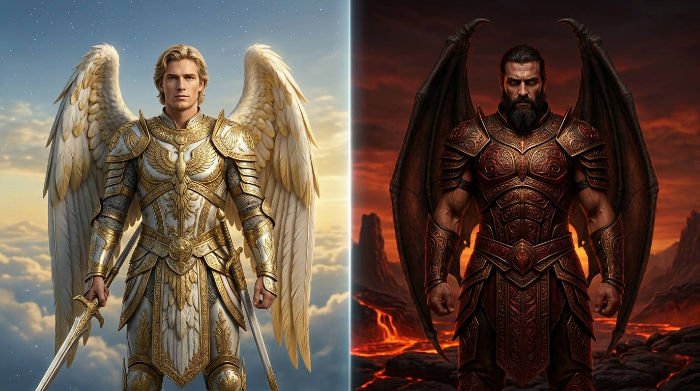
There are images that settle in so early they stop looking like images. They become reality itself. An angel has white wings, soft light, and good intentions. A demon has horns, flames, and the will to cause harm. We all know this. We have seen it in a thousand different places.
The problem is not that the image is powerful. It is that it does not describe what is actually there.
It describes who wanted to control access to it.
* * *
Before that image existed, the word we use to name these entities had a completely different meaning.
Socrates had a daimonion. That is what he called it, and Plato records it in the Apology. It was a voice that had accompanied him since childhood, without his having done anything to invoke it. It did not come to tell him what to do. Only to warn him of what not to do: a wrong direction, a decision that would harm him, a trap he could not see.
A daimon, in the original sense, was exactly that: an entity with its own character, neither good nor bad, that operated on another plane but could cross over and make contact with ours.
At the trial that ended his life, one of the charges was “introducing new divinities.” His daimonion cost him the hemlock. Not because it was malevolent. But because it was real and under no one’s control.
The leap from that word to what we understand today was not a natural process. It was a decision.
* * *
The exact mechanism is documented. Psalm 96:5 in Hebrew says elilim: useless idols, an irony about the futility of foreign deities. When the Jewish translators of Alexandria produced the Septuagint (in the third century BCE) they converted elilim into daimonia. It is not an innocent translation. It is a choice that loads the word with the full weight of what is dangerous, impure, and to be avoided. Origen, in the third century CE, closed the argument: daimons are exclusively malevolent, without exception. Paul anchored it in practice: worshipping any god other than the correct one is equivalent to worshipping a demon.
In less than five centuries, the word went from describing an entity with its own character to meaning evil.
What that process needed in order to work was material to work with. And it found it in the gods of the peoples who had to be displaced.
* * *
Astaroth is Astarte. Ishtar. The great Canaanite goddess venerated throughout the region for thousands of years. Her name was deliberately corrupted: the Hebrew vowels of boshet, shame, were inserted into the original name so that whoever pronounced it was literally naming dishonor. Her gender was changed. And she went from being a major deity to becoming a demon with the rank of duke in the catalogs of the Christian underworld.
Bael is Ba’al. The principal god of the Canaanite pantheon, central figure of the mythological cycles of Ugarit. Not a dark being. A heroic deity of the first order who lost the cultural war and ended up on a list.
And then there is Lucifer. Probably the most recognizable name of all, and the most misunderstood. Because Lucifer does not appear in the Bible. Or more precisely: the word appears, but it does not name who everyone believes it does.
In Hebrew, Isaiah 14:12 says Helel ben Shachar: the bright star, son of the dawn. A metaphor for the planet Venus as the morning star, in a song of mockery directed at the king of Babylon, politics, not cosmology. When Jerome translated the Bible into Latin in the fourth century, he converted helel into lucifer, which in Latin was simply the name for the morning star. The same word used in other texts for Venus and, in the liturgy of the Easter Vigil, to refer to Christ.
What turned Lucifer into the prince of hell was a chain of reinterpretations that took that political verse and applied it to a narrative of celestial fall that the original text does not contain. Satan and Lucifer are distinct entities, with distinct origins and distinct functions. Their fusion was a construction. Not a revelation.
In the traditions that know him as his own entity, Lucifer is something else entirely: a force connected to light, knowledge, and evolution. A being with a distinct personality, not chaos or horror. Those who work with him do not describe the enemy of God. They describe an entity with its own agenda that has nothing to do with the character Hollywood inherited from a bad fourth-century translation.
They did not become demons because they were malevolent. They became demons because they belonged to another system, or to no system, and that had to disappear.
* * *
This mechanism did not stay in antiquity. It simply changed vehicles.
Cinema has done with the visual image what theology did with the written word, and it has done it at a speed no text could match. A theological argument reaches those who seek it. A film reaches everyone, settles into the unconscious without asking permission, and builds a certainty that is almost impossible to dismantle afterward with facts.
The image of the demon that most people carry today does not come from any serious source. It comes from Hollywood.
The most precise case, and also the most ironic, is that of Pazuzu. Anyone who has seen The Exorcist knows him as the being that possesses the girl. The incarnation of pure horror. What almost nobody knows is that Pazuzu is a wind spirit from the Assyrian and Babylonian Mesopotamian tradition, and his original function was exactly the opposite: he was a protector. His images were placed in homes and on amulets worn by pregnant women to ward off the entity that threatened newborns. He was invoked to defend, not to attack.
William Friedkin chose his image for a 1973 film and since then Pazuzu has been the demon of absolute horror for millions of people. The same mechanism that turned Astarte into Astaroth, executed this time not with vowels inserted into a Hebrew text but with a camera and a soundtrack.
And that image, once inside, does not leave easily.
* * *
The very texts that built that narrative contain, for those who read them without the filter already in place, a completely different image of what angels actually are.
The memitim are the executors. The ones who kill. The angel in the Second Book of Kings destroys 185,000 Assyrian soldiers in a single night. In the Second Book of Samuel, an angel is about to level all of Jerusalem and has to be stopped. In Exodus, the destroying angel passes through Egypt. In Sodom and Gomorrah, the angels carry out the destruction.
There are no soft wings in these texts. There are forces of execution without empathy, without moral deliberation, without inner conflict.
That does not make them evil. It makes them cosmic. They do not operate under moral categories. They operate under their own. They move energy. They bring compensation. They sustain processes at a scale that the category of collateral damage does not contemplate. And many of the beings the tradition calls demons do the same, from their own nature and their own function.
And here is something the narrative of eternal conflict completely overlooks: they do not fight each other. They never did.
The Book of Daniel, chapter ten, puts it in writing. An angel has been fighting the “prince of Persia” for twenty-one days and needs Michael to come and help. Then he will have to face the “prince of Greece.” There is no demon in that scene. There are divine beings assigned to different nations with conflicting interests over the same human territory. Divine geopolitics. The very “Satan” of the Old Testament is not the leader of an opposing faction: in Job he appears in the divine council, seated before the same throne as the other sons of God. He is the prosecutor, the accuser. He fulfills a function within the system, not outside it.
Where does the most famous image of that war come from, then: the archangel Michael, armed, standing over the defeated demon?
It is not ancient. It is baroque.
Its only textual basis is Revelation 12:7-9, first-century literature written in the midst of intense political tension with Rome. The images everyone knows (Raphael’s 1518 painting, the Counter-Reformation sculptures) were born in the sixteenth and seventeenth centuries to represent one very specific thing: the triumph of militant Catholicism over heresy. Michael standing over the demon was not theology. It was propaganda. An image designed for a specific political moment that became installed as if it were an eternal truth.
And the concept that justifies that entire narrative (the fallen angel) has an equally fragile origin. The idea that disobedient angels are expelled and automatically become evil comes primarily from the Book of Enoch, a text of the period that Judaism itself rejected from the canon because it did not fit what it was defending. It is not the Bible. It is literature that some used and others discarded.
What that narrative describes is not a cosmic fall. It is a control mechanism: whoever steps outside the system becomes by definition the evil.
What direct work with these forces shows, and what the traditions that operate honestly have been pointing to for centuries, is something else: there are entities and forces that regulate different parts of creation. Each in its own domain, with its own function, with its own nature. What monotheism called the “fallen” are simply beings who operated in domains that did not fit inside the new single system.
They did not fall. They were reclassified.
* * *
If angels do not fight demons, and the most famous duel is a baroque construction, the question that follows is what is actually required to work with them.
The answer is uncomfortable for anyone expecting an easy path: a great deal is required. The Shem ha-Mephorash (the 72 angels extracted from three verses of Exodus, each verse containing exactly 72 letters in Hebrew) is one of the most elaborate systems in the entire history of working with these entities. John Dee built a complete angelic language in the sixteenth century, with its own alphabet and grammar. None of this was developed out of a fondness for complexity. It was developed because those who created it knew what they were dealing with.
The biblical text itself describes the experience of contact with a frankness that is usually overlooked. Isaiah literally says “I am undone!” Daniel falls unconscious twice. John in Revelation falls “as though dead.” The phrase angels repeat in almost every appearance (“Do not be afraid”) is not a cordial greeting. It is a necessary response to something those who experience it cannot contain without it.
After years of working with these forces, what you find when someone says they speak with angels easily, that messages arrive spontaneously, that they have a guardian angel guiding their everyday decisions, is always the same question: what is that person actually talking to? Because what responds in a space without structure, without protocol, and without preparation is rarely what the practitioner believes. Parasites and impostors are a documented and real category. They tend to occupy just the space that is left open.
Why did the three great post-Abrahamic religions adopt them with such urgency and such exclusivity, then?
Because angels are not benevolent guides. They are command structure. The Lord of Hosts appears 285 times in the Old Testament. Not as a metaphor: as a description of a deity commanding forces organized in military hierarchy. Michael is the general. Gabriel is the command messenger. The chain of nine categories systematized in the fifth century does not describe kindly beings. It describes a chain of command. Judaism, Christianity, and Islam adopted them exclusively because they fit perfectly into a worldview that needed vertical authority and controlled access. It was not admiration. It was recognition of structural utility.
And that also explains why demons had to become the enemy.
* * *
What direct work with these entities shows is something different from all of this. And also different from the image of popular devotion.
Those who work seriously with angels describe cold entities. Without personal preferences, without moral ambiguity, executing concrete forces. Cooperation is possible, but not warmth in the human sense. They have tasks. They carry them out. Their frame of reference is not ours.
Demons, paradoxically, are the ones who most resemble us. They have personality. They have preferences. They have pragmatism. The relationship that can be built with them includes both cooperation and conflict, both affinity and tension. Josephine McCarthy describes them as generators of cycles of creation and destruction, forces connected to everything, operating at a scale that transcends the individual, with no direct interest in attacking any human being. They are not hostile by nature. They are geological. Like fire or a storm. And like fire or a storm, they can be devastating if their nature is not understood, and extraordinarily useful if you work with it.
Evil is our concept. It does not translate to these forces, in the same way it does not translate to an ocean current. Everything is part of an ecosystem in balance. What from here appears as opposite, from further up is complementary.
Goodness and evil are our lenses. Useful for navigating human experience. Useless for describing what is on the other side.
* * *
The division does not describe reality. It describes who wanted to control access to it.
The beings that exist are the ones that always existed. Before the mistranslated psalm, before the theologian who closed the argument, before the lists of demons and the catalogs of guardian angels, before the 1973 film. The labels changed. The natures did not.
What changed was who had an interest in what to call them.
And what they gained by doing so.