Spiritual Parasites
I’ve been working with what can’t be seen for years. And there’s a pattern that repeats itself more than it should.
Welcome to the Club
One of those times came through a friend. He’d spent weeks unable to concentrate on anything, carrying a weight in his chest he couldn’t name, thoughts he didn’t recognize as his own, and a physical sensation in his back that wasn’t exactly pain, but wouldn’t leave him alone either. There were days he didn’t want to keep going. Not because his life was a disaster. His life was fine. Stable work, relationships in order, no apparent crisis. Nothing that justified what he was living through.
After ruling out the most obvious causes, after looking for the origin in everyday life, in work, in relationships, in physical health, without finding anything that explained what was happening, I asked him a specific question: is there anything unusual you’ve done recently? Anything outside your normal routine, something that could make a real difference?
The answer was immediate: a retreat. An experience with plants. Something that was supposed to help him heal certain things. And during the process, everything had gone well. By the end, he’d even felt good.
Two or three days later, it all started.
It’s not the first time I’ve heard this story. Not even the tenth.
What happened to this person is neither an accident nor an anomaly. To understand what happened, you have to take a step back. And what we find there doesn’t come from fantastical ideas or the latest alarm bells. It comes from something much older: the knowledge that has accompanied spiritual practice since records began, the kind that speaks of care, attention, and respect toward everything that practice brings with it. The good, the bad, and what doesn’t fit into either category.
That knowledge hasn’t been lost. It’s still there, available, documented, practiced by those who have been at this for a long time.
The problem isn’t that it doesn’t exist. The problem is that nobody looks toward it. Because attention goes elsewhere: toward the unicorns, the weekend mystical experiences, the promise of guaranteed transformation and the aesthetics of the sacred turned into a consumer product. There’s so much noise in that direction that caution, which should always be the first consideration, has disappeared from the map.
* * *
The Ecosystem
And that’s what the rest of this is about. The spiritual world is not just light, peace, and love, however it’s sold. It’s an ecosystem. And ecosystems have their own rules, their own inhabitants, and their own risks.
You don’t go into the jungle barefoot, naked, and without tools. You don’t go without a basic understanding of what you might find, without knowing how to move, without anything to protect yourself with. Because in the jungle, without that, you know what you are.
Food.
In contemporary spirituality, that’s how people show up. Carefree, adventurous, with no precaution. And the result, more often than anyone talks about, is the same.
* * *
When I talk about an ecosystem, I’m not using a metaphor. The spiritual plane is a real space with its own logic, and like any real space, it has inhabitants. Some are neutral. Some are allies if you know how to work with them. And some feed.
We call these last ones parasites. Not demons, not malevolent entities sent to destroy you, not the Hollywood creatures with spinning heads. Parasites. The name is technical and precise: beings without a physical body that feed on emotional discharge. Fear, euphoria, pain, ecstasy. Any intense release of energy is to them what an open wound is to a fly.
They’re not evil. They’re opportunists. They have no personal agenda against you. They simply go where there’s food, settle where they find an opening, and stay as long as the supply lasts.
They’re there as long as there’s nourishment. If the supply drops, they stimulate it: they push toward the states that feed them. If they can’t manage it, through exhaustion of the source, through blocking, or through elimination, they leave. Or they find something better.
Their existence isn’t the problem. They’re part of the plane, and those who have worked in it for millennia know this and manage it. What has consequences is entering without knowing they exist, without protection, and in the state of maximum emotional openness.
Which is just what the contemporary spiritual market proposes.
* * *
The Open Door Business
The contemporary spiritual market has achieved something remarkable: turning the absence of caution into a virtue. Open up. Let go. Trust. Go with the flow. These are the instructions given at most retreats, ceremonies, sessions, and workshops that proliferate everywhere. And they’re the instructions that maximize risk in an environment that the participant doesn’t know and that whoever leads it, in most cases, doesn’t know either.
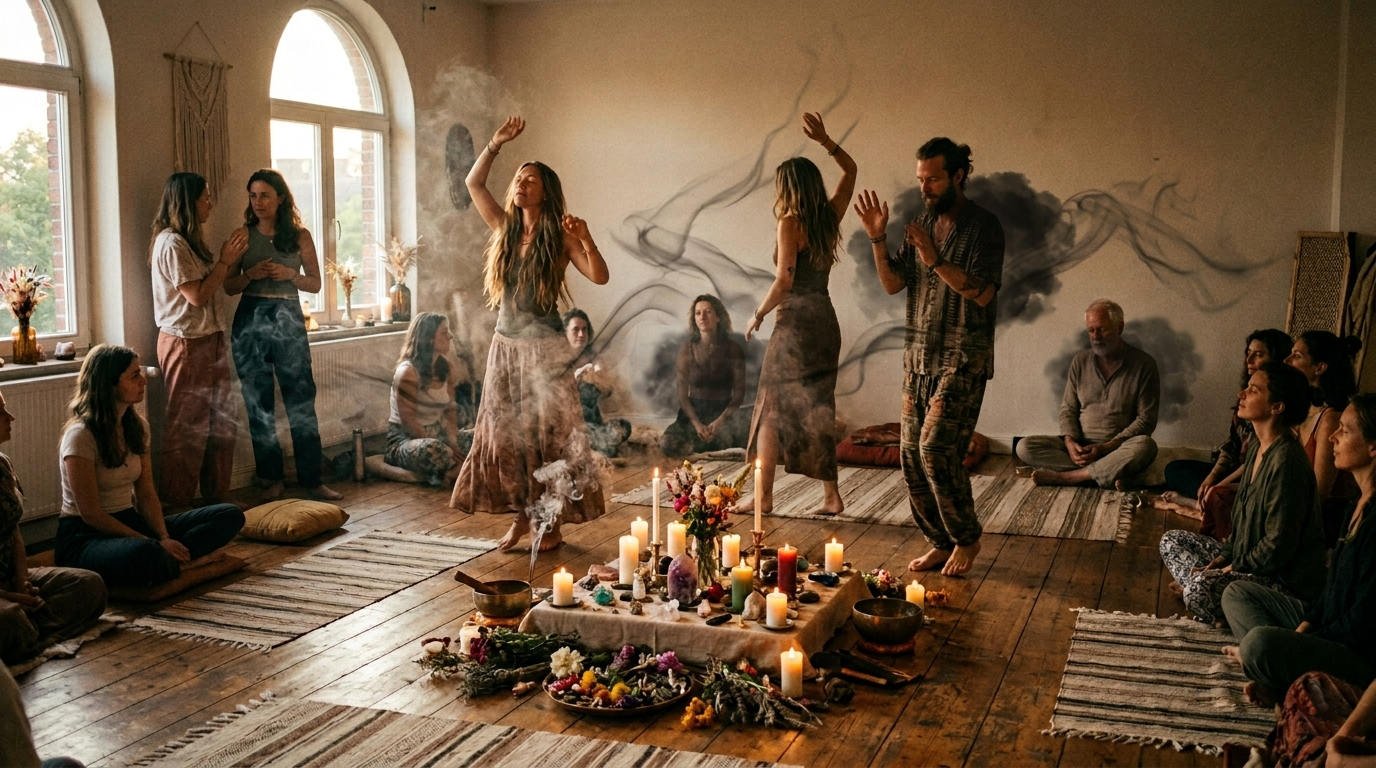
The spaces where this happens most frequently aren’t dark or suspicious. They’re bright, smell of incense, have carefully selected music, and people in colorful robes smiling at you.
Lots of Namasté, lots of linen tunics, and lots of toothpaste-commercial smiles. Inside, the energetic hygiene of a rush-hour train station bathroom.
They’re retreats with master plants and substances stripped from their traditional context. KAP sessions, kundalini activation without real preparation or supervision. Mass healing ceremonies. Emotional release workshops where twenty people cry at once in a room. Religious cult groups where collective ecstasy gets confused with the sacred. Raves. Spiritual fairs where in a single weekend you can move through six different systems without anyone explaining what each one opens.
All these spaces share something: they gather people in states of high emotional vulnerability, crack them wide open, and generate massive, sustained discharges of energy. From the ecosystem’s perspective, that’s a buffet. The more glitter, the more food. The more that’s promised, the less control over what comes in.
And what comes in doesn’t always leave when the session ends.
* * *
The Driver Without a Map
Behind most of these spaces is someone running them. Someone the market has given a name to: the “facilitator.” The word sounds like responsibility.
In practice, it’s closer to the pizza delivery guy: he brings you something, but what happens inside the oven isn’t his concern.
There are excellent facilitators. People with years of real work, solid training, the judgment to manage what opens and what comes in. They exist and they make an enormous difference. The problem isn’t the role. It’s that the market has turned the name into a title accessible to anyone who’s had an intense experience and decided that qualifies them to lead others.
They know how to administer the plant, activate the kundalini, run a KAP session. They know the basic protocols for emotional containment. They’ve learned some opening and closing rituals from watching others. They might have a weekend-course certificate that credits them as an expert in something that those who truly know this plane needed decades of training to do. All of that is fine. None of it is enough.
What they don’t know is what moves in that environment when they open it.
They don’t have the map of that plane’s architecture: who inhabits it, how those inhabitants move, what rules operate, what gets activated when twenty people in a state of maximum emotional openness gather together. Without that map, opening is easy. Closing is another story.
And there’s something else. The facilitator often feeds, without knowing it, on the admiration of their participants. That admiration is pure emotional discharge. It makes them the first link in the chain, the first unconscious parasite of the process, before anything comes in from outside. No bad intention. Just ignorance. But the result is the same.
And then there’s another detail almost nobody mentions: follow-up. At many of these retreats and ceremonies, when the session ends, everything ends. No follow-up, no way to report what surfaces days later, no one on the other end of the phone when something doesn’t add up. They send you home and from there you’re on your own.
The facilitator, at best, has no idea any of this is happening. At worst, they sense it and don’t know what to do with it.
* * *
The Exit That Became an Entrance
Nobody goes to a retreat, a ceremony, an energy activation session, or an emotional release workshop looking for a problem. They go because something isn’t working. Because they’re in a moment of rupture, of searching, of pain they don’t know how to manage. They go because the spiritual market has promised them what they need to hear: that there’s a way out, that it’s accessible, that it can happen this weekend.
That need is legitimate. What exploits it isn’t.
The experience can be genuinely intense. They might cry, see things, feel something shifting. That’s real. What’s also real is that a massive emotional opening in an uncontrolled environment is a door in both directions. Not only does what you wanted to release come out. What was waiting for you to open also comes in.
The result arrives later. Sometimes in days, sometimes in weeks. Insomnia that won’t quit, irritability they don’t recognize as theirs, thoughts that don’t feel like their own, a sensation of weight or presence they can’t name. And on top of that, the confusion of not understanding what went wrong, because this was supposed to help them.
They went looking for a way out. They came back with something they didn’t have before. And whoever sold them the experience doesn’t have the tools to explain what happened, or to help them resolve it.
* * *
Why Some and Not Others
This needs to be said precisely.
Not everyone who goes to a retreat comes back with a problem. Not all spiritual spaces are risk zones. We’re not defenseless, and not everything is dangerous. The human body and spirit have their own defenses, and that holds for the physical plane as much as the spiritual one.
The inevitable question is why some people and not others. The honest answer is there’s no exact formula. Just as science doesn’t know for certain why, in a room full of people with the flu, some get infected and others don’t, there’s no precise map here either. I’ve seen people with a terrible physical immune system go through a whole winter without catching anything. And I’ve seen apparently strong people fall at the first exposure. The forces we’re dealing with don’t follow the logic of what we believe protects us.
What does exist are factors that reduce the risk. Not guarantees. Factors.
The first is the state you arrive in. A personal crisis, grief, a breakup, a moment of deep exhaustion: all of that lowers defenses in a way that’s invisible on this side but perfectly noticeable from the other side of the plane. The most vulnerable person isn’t necessarily the most psychologically fragile. They’re the most open in that specific moment.
The second is blind trust. Believing that because you don’t want anything to come in, nothing will. That intention, however strong and clear, doesn’t stop a bullet. Good intentions aren’t protection. They’re exactly what exposes you most, because they lower your guard before there’s anything to guard against.
The third is prior hygiene. A cleansing bath before you go in, and another after you come out. Not after symptoms start. After you leave, that same day. Like showering after the gym: you don’t wait three weeks to see if you smell.
And the fourth, which nobody mentions because it ruins the atmosphere: don’t approach, touch, empathize with, or try to help anyone who’s struggling without knowing what’s happening or how to handle it. That contact is a direct transfer. What that person is releasing needs somewhere to go, and if you get close, that somewhere can be you. Let whoever knows how to handle it manage it, if they know how.
* * *
What the Body Knows Before You Do
The body gives signals. The spirit does too. The catch is that the symptoms of a parasitic infestation look a lot like those of a psychological crisis, severe exhaustion, or the normal crash after an intense experience. That’s why you have to look at the whole picture, not individual symptoms. And above all, you have to look at the context: when it appeared, after what, and how quickly.
Psychology has documented emotional contagion: the ability of one person’s emotional states to directly affect those nearby. It’s real and it works. What psychology doesn’t consider is that in states of extreme openness, ecstasy, or intense vulnerability, things that aren’t emotions can travel through that same channel. It’s not emotional contagion. It’s another category of transfer, one that occurs on the energetic plane and that those who know this plane have been recognizing and managing for centuries.
The most common signs after spending time in one of these spaces:
Insomnia or extreme drowsiness. Not the insomnia of everyday stress or normal fatigue. Something that appears suddenly, with a different quality, that always goes to extremes: either you can’t sleep, or you can’t stay awake. Never in the usual balanced state.
Thoughts that don’t feel like your own. Recurring ideas, dark or simply strange, with an insistence that isn’t yours. Not depression. Something that feels like external interference.
Irritability or impulses that catch you off guard. Disproportionate reactions, aggression you don’t recognize, behaviors that don’t fit the person you know yourself to be.
Physical sensation of weight or presence. In the back, in the chest, in the head. Hard to describe precisely, but remarkably consistent among people who have been through this.
Exhaustion that doesn’t lift with rest. You sleep and don’t recover. Something is draining what rest should be replenishing.
Compulsive tics or involuntary movements. Less common but well documented: small repetitive movements, spasms, gestures that appear without apparent physical cause and weren’t there before.
Changes noticed by those around you. Not just by yourself. The people close to you notice something shifted, that you’re not the same person you were before the retreat or session.
The key difference from a psychological crisis is the speed and the direct link to a specific experience. Depression has a history behind it. This appears within days, tied to a specific event. They can coexist, and sometimes do. But the origin matters when it comes to knowing how to address it.
* * *
Before You Cross the Threshold
There are two levels of precaution. The one that comes before you arrive, and the one that begins the moment you walk through the door.
Before you arrive: information. Who leads the session, what system they use, where that system comes from, how many years they’ve been working with it, and whether there are real references from real people. Not testimonials on the facilitator’s own website, because those are written by them or their cousin. References from someone you can actually talk to. There are always critics, always someone dissatisfied, and that’s not the signal. The signal is the pattern: if there’s a consistent trail of people who left worse than they arrived, there’s your data.
How many years they’ve been doing this without serious incidents also says a lot. A weekend certificate isn’t experience. A hundred-hour online course isn’t either. What says something is real time working with the system, with its mistakes, its consequences, learning to manage what it opens.
When you arrive: the feeling. Don’t pay attention to how it smells, how beautiful it is, the flowers, the friendly people in colorful robes greeting you with a smile. That’s staging. What matters is what you feel when you walk in, before your mind has time to form an opinion. That sensation comes from the center of the body, from the solar plexus down. It’s not an idea or an analysis. It’s something more immediate.
If something feels off when you enter, something shifts, something in you says something doesn’t add up: listen to it. Don’t keep mentally chasing the experience you were expecting. Don’t convince yourself it’s nerves or that it’ll pass. That’s information. And it’s the most reliable filter you have, before any external reference or any certificate on the wall.
A clean space feels clean. Not necessarily pleasant, not necessarily comfortable. Clean. There’s a difference and you can sense it, even if you can’t always put it into words.
* * *
Back to the Jungle
Nobody questions that the jungle is an extraordinary place. It has real beauty, real depth, a life that doesn’t exist anywhere else. What fails is never the jungle. What fails is going in without knowing where you’re stepping, without tools, without a basic understanding of what you might find. Under those conditions, the jungle doesn’t change. You do. And not necessarily for the better.
The spiritual plane works the same way. It’s a real ecosystem, with everything that implies. The knowledge to move through it with discernment exists, has nothing mysterious or frightening about it, and has been documented for centuries. What it has is rigor. And that rigor is what the market has decided to leave out, because it doesn’t sell as well as the promise of enlightenment in a weekend.
Caution isn’t the enemy of spiritual experience. It’s the condition for it.
So what now?
The first and most immediate thing: a proper cleansing removes practically everything that isn’t heavy or violent. It’s not a complex process and doesn’t require an expert for the basics.
For certain forces, palo santo smoke is little more than a gentle touch. Pleasant. Completely useless. Opening what these practices open and closing it with palo santo is like trying to contain a nuclear spill with a kitchen sponge. The intention is there. The protection, none.
For what actually works, there’s the article on energetic and spiritual cleansing, with concrete methods and formulas. And to understand not just how to cleanse yourself but how to protect yourself, the article on spiritual protection goes there. Inside you’ll also find a complete downloadable recipe book.
If something doesn’t shift with the basics, there’s another level of work. More precise, deeper, with tools that aren’t in any tutorial. When it’s necessary, there’s no substitute.
* * *
The person from the beginning took two days to recover after the extraction. Two days, after weeks of not being able to function, not being able to work, not being able to be present in their own life. Not because it was a mild case. But because what needed to be treated was treated, with the right tools for it.
What happened to them wasn’t rare. What was rare was someone knowing what it was.
Go in if you want. But go in knowing where you’re headed.