
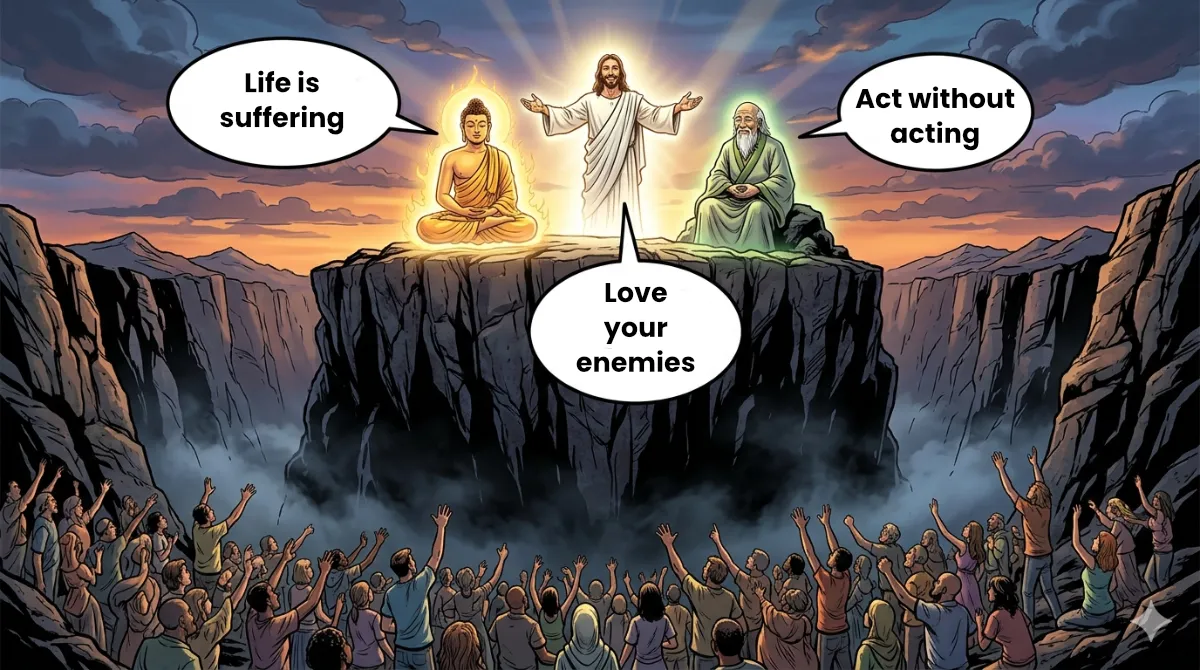
What the Great Masters Never Said
In 1983, a United States Army lieutenant colonel wrote a 29-page report on techniques for altering consciousness. The army commissioned it, a military man wrote it, and it had all the hallmarks of an internal document no one was ever going to read outside a Fort Meade office.
It was declassified in 2003. It sat quietly in an archive for twenty years. And then the internet arrived.
What came next deserves a moment of silence. The document, which dealt with brainwave synchronization and altered states of consciousness, became proof that the CIA had confirmed Jesus’s powers. Someone assigned him a mental level. Someone else made a podcast. Someone else made a podcast about the podcast. And a wave of people convinced that by tuning their brainwave frequency correctly they could achieve what Jesus achieved got to work.
The only thing missing was knowing exactly what to do.
That is where the problem begins. Not with the document. Not with Jesus. With that gap between hearing something and being able to apply it, the gap that goes completely unnoticed, and which is the only gap that matters.
* * *
Jesus said love your enemies. Buddha taught that suffering comes from attachment. Lao Tzu wrote that the wise man acts without acting, that he lets things happen.
Three different traditions. Three different historical moments. The same problem when someone tries to apply what they said.
Because none of them were speaking from where the reader stands. They were speaking from a place they had reached after a journey that does not appear in the phrases. Jesus was not describing a technique for getting along with difficult people. He was describing what he saw from a place where that was simply reality. Buddha was not offering emotional management advice. He was recounting what he had understood after a process that took years and involved considerably more than reading the summary.
What they described was true. But it was the truth of someone who had already reached the other side of the river and was sending back a report of what was there. Accurate, detailed, useful for knowing the other side exists. What that report did not say was how to cross. Because for someone already on the other side, crossing the river stopped being a problem so long ago they no longer remember it as one.
And then someone comes along, reads the report, and tries to use it to cross.
* * *
This is where Krishnamurti comes in. Not as one more great master, but as the only one who eventually said it out loud.
He spent sixty years travelling the world explaining something that seemed completely obvious to him. Conferences, books, conversations with physicists, philosophers, ordinary people. Sixty years. Shortly before his death he made a statement that did not sit well with the image of the illuminated master surrounded by devoted followers: that no one had understood what had passed through his body. That perhaps they would understand something if they lived the teachings. But that no one had. No one.
It was not the spectacular part. It was not what people had come looking for. So no one paid much attention.
Buddha, for his part, doubted whether it was even worth teaching after reaching what he reached. What he had seen seemed too difficult to understand for anyone who had not walked the same path. Someone had to convince him to try anyway.
None of them were hiding anything. There was no bad faith. And all of them, in one way or another, taught the path. Buddha built an entire system for walking it. Jesus accompanied his disciples for years. Krishnamurti spent sixty years explaining the process with unusual precision.
The problem was not in what they taught. It was in what people chose to hear.
Because phrases shine. The path does not. “Love your enemies” sticks. The three years of accompaniment that came with it, not so much. People separated the spectacular from the necessary, and no one posted the warning that one without the other does not work. It is like someone who has spent decades playing guitar explaining how they do it and forgetting to mention that first you need to know how to play. People learned Eddie Van Halen’s tapping technique and expected to sound like him. They did not. The technique without the journey is just a gesture.
Someone who finishes a three-month design course has the knowledge, the tools, the documents. What they do not have is the eye. That is not taught in three months. It is built by facing real problems over years. Without it, everything else is theory.
* * *
Not long ago, someone who requested my services asked me whether it was possible to achieve something specific. I am not going to go into details because they are not relevant. I said yes.
Their immediate response was: I want it.
I explained that to get there, certain things had to happen first. That the result was real but came afterwards, not before.
They did not like hearing that. And then came the question that sooner or later everyone asks in that situation.
Have you achieved it?
Yes.
Then I want it now.
But you are not where I am. And you are not here because you have not been where I have been. Not because of a question of ability. Not because I have something you cannot develop. But because there is a distance between the two points, and that distance cannot be skipped. The same tools, the same knowledge, applied from a different place, produce a different result. Or no result at all.
That is what Krishnamurti did not finish saying in sixty years of conferences. What Buddha doubted was transmissible. What Jesus and Lao Tzu left out without realising they were leaving it out, because for them the path and the destination had become the same thing.
The teachings are not incomplete. They arrive alone, without the context of where they were generated. And without that context, the listener does the only thing they can: tries to apply them from where they stand. Which is not where the one who formulated them stood.
* * *
There is a question almost no one asks before trying to apply a teaching. It is not complicated. It is the most obvious question of all, which is perhaps why it is the one most often avoided.
Where are they speaking from?
Not what they say. Not how they say it. Where from.
Because the distance between the one speaking and the one listening is exactly what separates a useful teaching from a pretty phrase that leads nowhere. And that distance does not shrink by finding the right document, or tuning your brainwave frequency, or landing on the right podcast.
It shrinks by walking the path. Which is slow, uncomfortable, and has nothing spectacular about it.
Which explains perfectly why no one sells it that way.