Dogmas in Spirituality
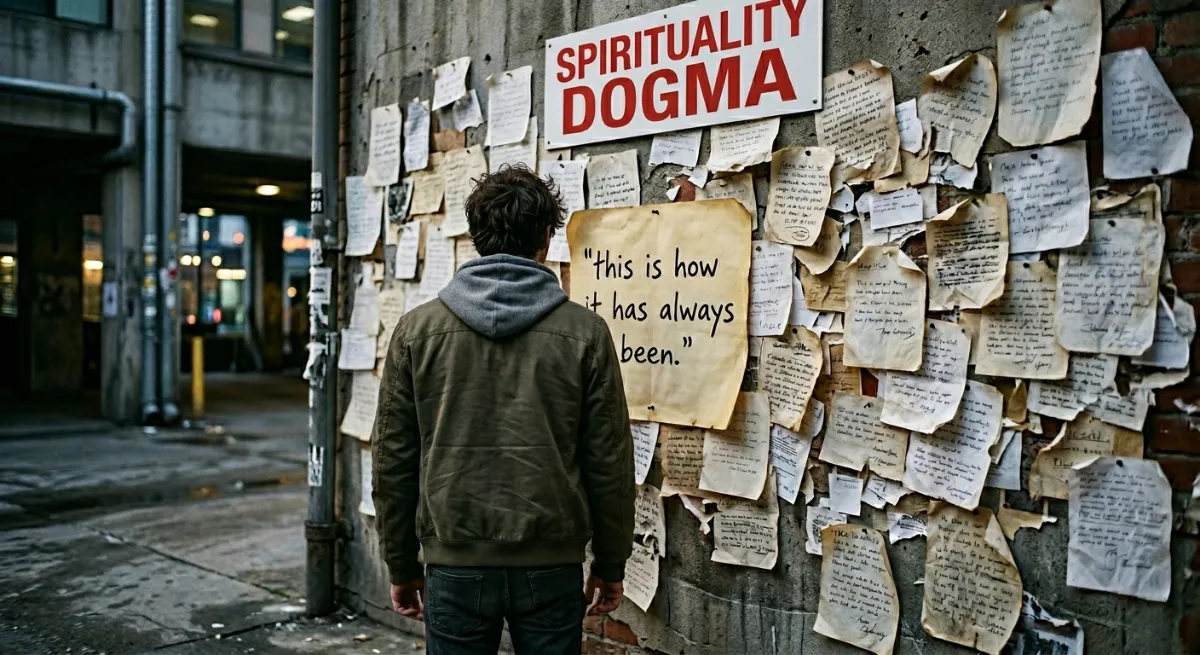
Someone said it. Someone repeated it. At some point it lost its author and became a rule. Nobody asked where it came from, nobody checked it against anything, and today it circulates with the same authority as a law of physics.
I see it constantly in sessions. Someone comes in and before they even explain what’s going on they drop one of these: “I’ve been told that if I do this kind of work I can’t eat meat.” Who told you that? Silence. And based on what? More silence.
What follows are thirteen statements that circulate in the spiritual world as universal truths. The number is not a coincidence. Some come from real traditions that got badly misread. Others came from nowhere and installed themselves without anyone questioning them. They all have one thing in common: they don’t survive two questions in a row.
One thing before we start. Taking apart a rule is not an invitation to do the opposite. If this article says alcohol isn’t forbidden in spiritual work, it’s not saying you should show up to a ritual drunk. If it says eating meat doesn’t disqualify you, it’s not saying live on steaks. The only goal here is to show that these statements don’t have the universal foundation they claim to have. What you do with that is up to you.
The body and its habits
1. If you do spiritual work you cannot have sex
There’s a real observation behind this one, but it’s been told wrong. In certain people and at certain times, sex, some foods and particular states can affect the level of stillness and focus that spiritual work requires. That was observed and in some traditions became a practical guideline: if you’re going into work that demands full focus, take care of your state beforehand.
That part makes sense. What happened next didn’t. The guideline left its context, lost its explanation along the way, and arrived here as a universal rule with no nuance, no context and no intended audience.
There are people who need a state of maximum purity to get a minimum result. And there are people who pay no attention to any of that and do things that leave you speechless. If the rule were universal, the second kind couldn’t exist.
Grigori Rasputin. Siberian peasant, no formal training, no recognised initiation. A life of excess that is completely documented: orgies, alcohol, behaviour that shocked even Tsarist Russia. His healings were talked about as much as his orgies, and his abilities were confirmed even by people who despised him. The Russian historian Igor Zimin wrote that there is no doubt he possessed hypnotic therapeutic technique.
Aleister Crowley. One of the most influential occultists of the twentieth century, founder of Thelema, author of more than 80 books on magic that are still referenced today. Heroin, cocaine, hashish, alcohol, sexual rituals, excess in every possible direction, all documented by himself and by those around him. His influence on Western occultism is undeniable.
The rule didn’t apply to either of them. Both of them worked. It was a guideline that someone turned into a dogma.
2. If you do spiritual work you cannot eat meat
In ancient Greece, eating meat was already associated with licentiousness and impurity. Ancient medicine linked meat with excess and imbalance. Christians inherited that idea, codified it, and from there it reached modern spirituality without its original context.
It’s true that meat and certain foods create a state of greater agitation in some people that can interfere with certain types of work. In processes that demand maximum focus, some practitioners choose not to eat it temporarily. That’s a tool for occasional use, not a rule.
But there’s an argument that dismantles this from the ground up. Animals are not just physical world beings. Every shamanic tradition knows this: animals have a direct connection to the spiritual world, to spirits, to the invisible matrix of reality, in a way that human beings have lost or have to recover through effort. They live in that state constantly and naturally, without practice, without ritual, without effort. In that sense, they are more spiritual than most of the people who are trying to be.
And they eat meat. The wolf eats meat. The fox eats meat. The tiger eats meat. The connection to the source doesn’t break because of that. Something doesn’t add up in this rule.
3. If you do spiritual work you cannot drink alcohol
Until the eighteenth century it was safer to drink wine than water in European cities, because fermentation killed part of the bacteria in the water. People didn’t drink out of vice: they drank because water was dangerous. In that context, being drunk was the normal state of a significant part of the population. Telling someone in that moment to abstain before ritual work meant something completely different from what it means today.
The original guideline wasn’t “never touch alcohol.” It was “don’t show up to the work drunk.” One is judgement. The other is dogma.
Eckhart Tolle, considered by Watkins Books in London to be the second most spiritually influential person in the world, explained in an interview that he has a glass of wine a day, sometimes two, with no effect on his state of presence whatsoever. When he goes past that, he does notice the effect. That’s not abstinence. That’s judgement.
And in Mayan ceremonies, the ritual wine balché, fermented tree bark mixed with spirits, is part of the sacred work of gratitude, petition and protection. It’s not forbidden. It’s part of the ritual.
* * *
Spirits and spaces
4. Working with certain spirits contaminates you forever
This one wasn’t said by a fraud. It was said by someone I know, with years of real experience and genuine abilities, who had inherited that idea from their own circle without ever verifying it. And they passed it on with the same authority as what they actually knew from direct experience. That makes it a more honest example than any other: dogma doesn’t only come from the ignorant. It also comes from those who know, when they stop questioning what they were taught.
The argument that takes it apart is simple: space and person cleansings exist in every documented shamanic tradition, from the Mapuche in South America to the Maya in Mexico, for thousands of years. Plants, copal smoke, specific rituals to remove energetic charges. If contamination were permanent and irreversible, those practices wouldn’t exist. Nobody teaches a tool for millennia that doesn’t work.
There is residual charge after certain work. That’s real. In places where there have been massacres, wars, mass death, that impregnation exists and it’s intense. But even in some of the most burdened places in history, people with an extraordinary level of spiritual development have flourished. The charge affects. It doesn’t condemn. And with the right knowledge and tools, anything can be cleaned.
5. The occult is satanic or evil by definition
The word “occult” literally means hidden, concealed, beyond ordinary reach. Not evil, not diabolic, not dangerous by definition. The devil is a specific construct of Christianity. The traditions that work in that territory have no relationship with it, partly because they don’t share the same cosmology.
What the Church called “occultism” was everything that escaped its control and gave people direct access to the invisible without needing an ecclesiastical intermediary. The label “satanic” was the tool to shut that access down. It worked for centuries. The residue is still circulating today, even among people who have no relationship with Christianity whatsoever.
* * *
The master and the gift
6. Spiritual masters were born special. You will never reach where they are
The most paralyzing of all, because it turns something that depends on work and conditions into something that depends entirely on origin.
It’s the same tomato in dry soil or fertile soil: in one it grows, in the other it doesn’t. It’s not a different tomato. It’s different conditions.
There are people who are born with characteristics, abilities or contexts that give them an advantage in developing certain things. That exists. I know people with ability at a completely different level from the moment they arrived in the world, who at some point decided they didn’t want any of it: better a simpler life, a more ordinary one, a blinder one. If they had followed the direction their abilities pointed to, they would have been extraordinary. They weren’t, because potential without development goes nowhere.
A head start doesn’t guarantee the result. And the other way around: people with no particular starting advantage, through work and the right conditions, reach places where others with every advantage never arrived.
Buddha was a prince. Born into a family of wealth and power, raised in a palace where his father made sure he never saw illness or death. He lived in luxury until he was 29. At that age he left everything behind to search. He tried extreme asceticism, total fasting, complete deprivation, and nearly died. He abandoned that too. What he found was what he called the middle way: neither luxury nor extreme deprivation. And in that process he deliberately created the conditions for his own development. It didn’t fall from the sky. He built it.
Jesus, according to the non-official historical currents and the texts the Church discarded from the canonical version, spent years travelling and training before beginning his public life. Both of them created the conditions. That’s what they did.
7. Spiritual masters don’t make mistakes
Sathya Sai Baba. Indian guru with tens of millions of followers worldwide, considered by his devotees to be an avatar of the god Shiva, one of the most revered spiritual figures of the twentieth century.
He predicted he would be recognised as king of the entire world from the year 2000. He predicted that Muslims would recognise him nine years before his death. He predicted he would live to 96. He died at 85. He announced specific dates for a golden age of transformation of human consciousness that he kept postponing when it didn’t arrive.
None of those predictions came true. And no follower could question it, because the master’s infallibility was the central dogma of the system. When a prediction failed, it was reinterpreted. An explanation was found. A new date was announced. The master was never wrong, the prediction simply hadn’t been fulfilled yet.
That’s the dogma working: it’s not just that the master is wrong, it’s that the environment builds a mechanism so the error is never recognised as such. While the power holds, nobody sees anything. Only when he dies and the power dissolves do people start looking at what was there.
A master with real knowledge can be wrong. In some areas they will have direct experience. In others they will have inherited ideas without verifying them, just like anyone else. The difference between a master and a walking dogma is that one of them recognises it and the other builds a system so it never becomes visible.
8. You have to be poor and humble to have real spiritual abilities
Buddha chose renunciation because he understood that having too many things forces your attention onto too many things, and that got in the way of the state he was looking for. A strategic decision to create the conditions he needed. Not a universal rule.
Eckhart Tolle has an estimated net worth of 80 million dollars. He is considered the second most spiritually influential person in the world by Watkins Books in London. Deepak Chopra also exceeds 80 million, with books translated into dozens of languages and global conferences. Thich Nhat Hanh, Buddhist monk nominated for the Nobel Peace Prize by Martin Luther King, founded monasteries on three continents and managed a worldwide organisation for decades. None of the three lived in poverty. None of them stopped being what they were because of that.
If poverty and humility were real requirements for maintaining the spiritual level reached, all of them should have given away their wealth and lived on only what they need. As far as we know, that’s not happening.
* * *
Practice
9. If you doubt, the ritual won’t work
Chaos magic, developed in England in the 1970s by Peter Carroll and Ray Sherwin, treats beliefs as tools, not requirements. The practitioner doesn’t need to believe in a system for it to work. What they need is conviction and focus in the moment of the work.
These are two different things. Belief is a mental position sustained over time. Conviction is total concentration on a single point during the working state. You can have doubts about whether something will work and still bring full conviction to the moment you’re in. A surgeon doesn’t need to believe the operation will go well for their hands to do the right thing. They need focus and technique.
10. You need formal initiation to practise anything
You don’t. You can practise whatever you want whenever you want. The results will be different, yes, but initiation is not the key without which nothing works.
If someone shows you how matches work you light them better and more safely. If you figure it out yourself, you also light them, but you might burn your fingers. Initiation exists for real reasons: it gives consistency, focus and safety. But it’s not a technical requirement for something to work.
For years I practised a specific technique of deep shamanism without knowing that’s what it was, without anyone teaching me, without any initiation of any kind. At a later point, a practitioner with decades of experience in that territory asked me where that knowledge came from. My answer was: from nowhere. It had just appeared. The knowledge didn’t wait for the initiation.
* * *
Inherited morality
11. The more you suffer, the more you advance
Suffering can be a catalyst, not a requirement. There are people with genuine spiritual clarity and power who haven’t come from a point of extreme suffering. If it were the universal requirement, those people couldn’t exist. And they do.
What’s behind this is the structure of Christian martyrdom transplanted into modern spirituality without the label. The one who suffers is the one who deserves. The one who deserves is the one who advances. That’s religious logic, not spiritual logic. And guilt, as a tool of control, has been working for centuries. It’s still working here, just wearing different robes.
12. You cannot do magic during menstruation
Exactly the opposite.
In the traditions with real roots, the oldest ones and those furthest from Western religious influence, menstruation is not impurity. It’s power. Menstrual blood is considered sacred in Maori, Sioux, Mapuche, Kogi, Shuar and Mbuti traditions, among others. According to anthropologists Thomas Buckley and Alma Gottlieb, in hunter-gatherer societies the observation of the menstrual period was experienced positively, with no connotation of impurity whatsoever. In the Australian Aboriginal tradition, menstruation synchronised with lunar cycles was considered to confer spiritual power.
What circulates today is the exact inversion of that knowledge. Centuries of monotheistic religion associating the female body with impurity flipped the meaning, and the residue arrived here, even in people who have no relationship with those religions.
What women say in sessions who have been working from inside this territory for years confirms the same thing: during menstruation there is more, not less.
As Cervantes wrote in Don Quixote, we have run into the Church again, Sancho. Though to be precise, what he actually wrote was slightly different from the version everyone quotes. But then again, that’s exactly what this article is about: things everyone repeats without checking.
13. Whatever you do will come back to you threefold
The threefold law. Wicca, 1949, Gerald Gardner. It isn’t ancient, it isn’t universal, it has no basis in any tradition predating the mid-twentieth century. It’s a specific belief from a specific system that left that system and installed itself in the general spiritual world as a cosmic law.
It cannot be demonstrated. There is no explained mechanism. There is no evidence it works that way. Useful within the system that generated it as a tool for moral self-regulation. Outside that system it’s a rootless dogma, with no known author for most people, and seventy-seven years of history dressed up as ancestral wisdom.
As if karma weren’t enough, already conditioning countless actions without anyone having consistently explained how it works, some ladies and gentlemen came along and decided to multiply the fear by three.
We’re doing fine. We’re doing juuust fine.
* * *
The two questions
After thirteen dogmas, there are two questions that dismantle all of them. No elaborate argument needed. Just ask them and wait for the answer.
The first: why?
The second: based on what?
If the answer is consistent, has data, has internal logic, has a traceable origin, the dogma might have a foundation. If there’s silence, evasion, or the answer is “because everyone says so” or “because it’s always been that way,” you already have your answer.
Next time someone tells you “they say this is how it works,” ask them who. And wait.