—I’m awakening.
—To what?
—To a lot of things.
—Like what?
—Things I didn’t see before.
—Okay, and what do you see now?
—That everything is different.
That’s the usual thing. Someone notices something, opens up to things they didn’t pay attention to before, and sticks a big name on it. But let’s go a little further. Different how? What do you see now that you didn’t see last month? And that’s where it starts to get hard. «I can feel it.» Right, but what do you feel. «I feel like I’m not the same.» In what way are you not the same? «It’s hard to explain.»
Awakening, as a word, is a beautiful thing. It sounds like a flower opening. If you were asleep there were things you couldn’t see, and now something bigger and truer opens up in front of you. Who wouldn’t want that.
And there is an awakening that really exists, let’s be clear from the start. Becoming aware, seeing that the world wasn’t what you thought, that there are layers under what you touch. That happens, and when it happens it hits hard. It usually arrives slowly, looking inward, or all at once, unsought, pulling the ground out from under your feet. The old word for it was enlightenment, which sounded far away, a monk on a mountain. Now we call it awakening, which sounds closer, more yours, more within reach. Twenty years ago almost nobody used the word. Now everybody says it, and not under their breath. It gets announced, worn, put in the bio next to the star sign. It has stopped being something that happens inside you and become something you display. And that’s where the mess begins.
Because most people aren’t talking about that. They’re talking about something else they’ve given the same name.
* * *
The sack that holds everything
Look at what people put inside the word awakening.
Someone starts noticing things they didn’t notice before. They catch themselves thinking the same thing as a friend right as the other is about to speak. Someone comes to mind and that person calls. They notice that certain places drain them and certain people leave them with no strength. And hold on here for a second, because there’s something real in this. There are connections between people that psychology can’t explain, there are synchronicities that happen, things that run below the visible and are there. I’m not going to deny that to anyone. I work with it.
Noticing is fine. What grates is the bill you write yourself from there on.
Because from «something curious happened to me» you jump, with no stop in between, to «I’m awakening to a higher level of consciousness.» And that’s another thing entirely. It’s one thing for two stray thoughts to cross your mind and another to think you’re the Buddha for it. Between the one and the other there’s an abyss, and they cross that abyss in a single leap, without looking down.
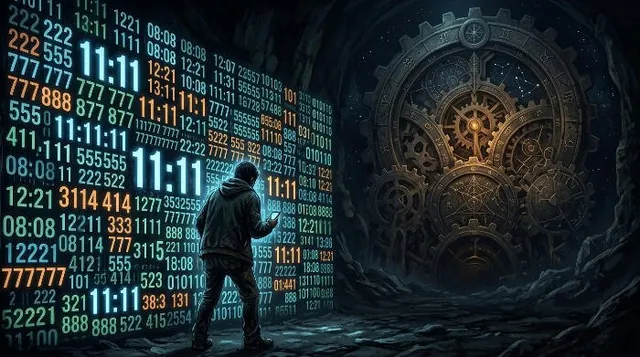
And then the sack fills up. Inside fit the synchronicities, but also the repeated numbers on the clock, the strange dreams, the shivers, the mid-afternoon tiredness, the bad digestion, having given up meat. All of it a sign. All of it proof. I’ve seen lists that put a headache with no medical cause as a symptom of awakening, right next to complete bliss. So you level up whether you’re immensely happy or you’ve got a headache. A sack that holds anything you feel measures nothing. It only collects. And, look, that sack holds everything except the one thing that would actually be hard to fit in: the ugly part. The lists promise peace, fullness, pretty shivers. Never the collapse.
* * *
Seeing pictures in the clouds
What joins the 11:11 to the bad digestion is that someone has put them on the same list. And that reflex is very human: we see patterns and connections where there are none, we draw a line between things that only coincided by chance. It’s not the work of four enlightened types, it’s built in, we all do it. The brain hates randomness and fills in. It sees a face in a power socket and a plan in a run of bad luck.
And when does this go off? Sometimes, when you feel that something doesn’t fit, that there’s an emptiness in your life or that you need to find something that gives it meaning. You start looking, and when you look for meaning, you start finding it everywhere. Anything that happens to you, you hook it to something else and there you have a sign. And since the signs confirm you’re on the right track, every day you collect a few. The system feeds itself.
That same mechanism, the one of seeing pictures in the clouds, is what leads one person to read the 11:11 as a message and another to build a worldwide conspiracy. It’s the same fault with two sets of scenery. That’s why the one who «awakens» down this road ends up, so often, in the same place: the elite that controls everything, the poison in the food, the hidden plan and, in the end, the Arcturians coming to lend a hand. He started by noticing a real synchronicity and he’s ended up waiting for a spaceship. Not because he’s crazy, but because, once you start connecting anything to anything else, there’s no stopping you.
* * *
Set yourself to awake and go out for a walk
Let’s test it.
Decide that you’re awake. That you’ve become aware, that you now see things you didn’t see before. Very good. Now go out for a walk.
Look at the ground, the trees, the stones, the streetlights, the houses. But look at them for real. Don’t walk past the way you walked past yesterday. Stop for a moment. Observe. What do you see now that you didn’t see before? What has changed in the way you look?
Because when you really awaken, it’s not that everything suddenly becomes wonderful, or that every stone hides a message for you. You see things differently. Everything is there, just as it was before, but now you see it and, at the same time, you don’t need to find anything in particular. Things make sense just as they are, without your having to invent it for them. And you understand something about the reality around you, even if you can’t put it into words.
Now look at that stone again. It doesn’t have to mean anything special. It doesn’t have to be a sign or hide a lesson. It’s there. And yet, you can come to perceive it in a way you wouldn’t even have imagined before. It isn’t so separate from everything else, nor everything else so separate from you. And that understanding also changes the way you relate to things. You respect them in a way you wouldn’t have understood before.
Now tell me: what has changed in the way you look? Because if you’ve spent years saying you’ve awakened, but you don’t know what has changed beyond the words you use to describe it, what are we talking about?
* * *
A dream inside another
Something very specific happens, and it happens to a lot of people.
Sometimes something happens in your life, someone tells you a thing, you read something, you have an experience, it doesn’t matter. Something clicks. And your head opens up. You see something you hadn’t seen. Suddenly a lot of things fit together and you understand something that until that moment had escaped you. That’s magnificent, one of the best things that can happen to you.
But the dazzle is so strong that you take one step too many. You start to believe that, from inside your same situation, with the same house, the same job and the same problems, you’re already looking from the outside. A new world opens up for you, everything seems different, everything takes on another meaning. You talk about other things, you consider other things, you look at life another way. And yet, there you still are.
You’ve rearranged the furniture and you think you’ve moved house. You’ve realized you were dreaming and, instead of waking up, you’ve started dreaming that you were waking up. A dream inside the dream. And from inside it looks crystal clear, which is why it’s so hard to notice. Until the years go by, and there you still are, in the same room with the furniture moved around.
With someone who got there through an experience with ayahuasca, mushrooms or whatever, something similar can happen. Sometimes they take it worse, because they’ve come back from the trip and don’t want to have come back. There everything fit, everything got resolved, everything was luminous. And it’s true that it got resolved. In their head. In life, the problems were waiting for them at the door, intact, when the lights came back on.
* * *
And who holds the gauge?
If everyone who says it feels it with the same force, there’ll have to be something that says which one is the real one. A rule, a mark, a gauge.
Charles Manson felt awake. He was convinced he saw a plan the others didn’t see, that the Beatles were speaking to him, that he’d understood something the sleeping world was incapable of understanding. Marshall Applewhite too. He convinced thirty-nine people that they’d gone beyond the human level and that a spaceship was waiting behind a comet to pick them up. Both felt it with absolute certainty. The same certainty, on the inside, that the weekend-retreat guy feels.
So, which is the gauge? What rule puts one on one side and the other on the other? You go looking for it and what shows up are the lists. «Twelve signs you’re awakening.» «Seven proofs you’re an old soul.» You read them and none of them matches any other. And on top of that they protect themselves: they warn you that awakening never ends, that there are always levels ahead. A goal that steps aside just as you get close, so you can’t check whether you arrived and nobody can hold you to account.
* * *
«Not that one»
And there’s a detail that throws the whole thing off. Ask one of them what being awake is and he gives you his list. Go to another, who also calls himself awake, and he gives you a different one. Go back to the first and tell him that the other one is awake too. He answers: «yeah, but not that one.»
In those three words something very old shows up. His is the real awakening and the other one’s is an imitation. The genuine and the fake, the ones who know and the ones who are wrong. That’s had a name for centuries and it isn’t spirituality. It’s the same old division: my version is the good one, yours is the mistake.
Look at it from a distance and it’s a group apart that is apart from other groups apart. Each on its own island, each with its own list, each seeing the other awakened ones as sleepers who think very highly of themselves. The best part is that the one who contradicts you does so, of course, because he’s still asleep. Set up like that, there’s no way you can be wrong: any objection is proof that the other one hasn’t arrived.
* * *
What really splits you in two
But I don’t want it to seem like awakening doesn’t exist, because it does. The thing is it looks nothing like this.
The real one isn’t a collection of pleasant sensations or a membership card for those who see. It’s a blow that throws you backward. A becoming-aware so large that you can no longer go on with the life you were living. It’s not that you calmly decide to change it, one morning, after coffee. It’s that something has changed and you can no longer look at things the way you did before.
The Buddha was a prince with a full palace. He saw old age, sickness, death, and the life he had became unbearable. He left at night, left behind his wife, his newborn son, the whole kingdom. Not because he’d mulled it over slowly, but because what he’d seen made it impossible to stay. Eckhart Tolle hit bottom one night, at twenty-nine, with a depression he couldn’t bear. Out of that night came another person: he spent years wandering, jobless, and his own family gave him up for lost. His life changed from top to bottom. It didn’t add a hobby.
And here’s what the sack of signs never collects: that blow, almost always, hurts. It’s not a comfortable enlightenment, it’s a crossing of desolation. It’s had a name for five centuries, the dark night of the soul, which Saint John of the Cross described as the soul’s passage through the darkness before reaching any light. And it has a recent name too: the psychiatrist Stanislav Grof called it spiritual emergency, the process of transformation that from the outside gets mistaken for a breakdown, for falling apart, for losing your mind. That’s why Tolle’s family gave him up for lost. The real awakening, while it’s happening, often can’t be told apart from a collapse. But the night has a morning. Tolle says that the next day everything was calm, the calm of there being no one left arguing with himself. That’s the luminous part, and it comes after the night, not in its place. The fake one, on the other hand, is all highs and good vibes. It wants the medal without going through the night.
That’s awakening. Not because it necessarily leaves you without a job, without a partner or without a house, but because it changes you in a way you can’t mistake for having learned a few new things. Maybe you can’t explain it, maybe it takes you a while to understand what has happened to you, maybe for a time you don’t even know what to do with it. But you know something has changed, and that change ends up calling into question things you’d never even considered before.
And this is where the account doesn’t add up, because you look at the one who goes around saying he’s awakened and, five years later, he’s exactly the same, except for the concepts he’s added to his vocabulary. The same certainties, the same way of positioning himself against the world. He doesn’t seem to have discovered anything that forces him to revise even one of his own convictions. He’s changed the story, but the story still talks about him the way it always did.
* * *
The tree didn’t take anything
Osho, whom a lot of people take for a master, used to tell that he awakened one very specific night. On the 21st of March 1953, at twenty-one, sitting under a tree, he had an experience he described as his enlightenment. The date was recorded down to the day, and the tree had a name too: maulshree. According to his account, that night everything turned to light and silence. And he also told that the garden was asleep, that the trees were asleep.
Curious, because the tree is the only thing in the scene that hadn’t set out to awaken.
The tree didn’t take the course, didn’t date its enlightenment, doesn’t keep a list of signs or a certificate of attendance. It is. It doesn’t need to explain to itself what it is or convince anyone that it’s gotten anywhere. And meanwhile, look what we do with it: from that same tree in Jabalpur someone has extracted the genes to clone it into eleven saplings, and there are people asking to rename the whole city in its honor. The tree that, according to the account, was asleep, gets sacred cuttings taken from it and they want to put its name on a map. It goes on about its business.
Whitman said it better than any guru, and without a robe on:
I think I could turn and live with animals, they are so placid and self-contain’d,
I stand and look at them long and long.
They do not sweat and whine about their condition,
They do not lie awake in the dark and weep for their sins,
They do not make me sick discussing their duty to God,
Not one is dissatisfied, not one is demented with the mania of owning things.
The animal doesn’t go around looking for meaning the way we look for it. It doesn’t need to build a theory about its existence or turn into a superior version of itself. It’s busy living.
And no, it’s not that animals are enlightened or that we have to go back to the caves. It’s about looking at what we do. The noise we raise around our own existence, the need to put a name on everything, to find signs, to climb levels, to prove that we know something the others haven’t understood yet.
What separates us from the tree isn’t that it’s less awake. It’s the noise. The more head, the more theory and the more certainty of climbing, the easier it is to lose sight of the only thing the tree has never needed to learn: being here without having to argue about it.
This article draws on many years of my own work and on a few checked references: Osho’s account of his enlightenment under the maulshree tree in Jabalpur (21 March 1953); the dark night of the soul of Saint John of the Cross; the concept of spiritual emergency, coined by Stanislav and Christina Grof; and the lines by Walt Whitman are from Song of Myself (section 32), in the original. What is my own interpretation, I hope it’s clear that it is.