Healing
A word that doesn’t say much
“I’m healing.”
Two words. And yet, if you ask the person saying them what exactly they’re healing, the silence that follows has the same texture. Dense. Uncomfortable. Full of words that are about to come out but never quite manage to say anything concrete.
Healing relationships. Healing bonds. Healing the root. Healing the bond with your mother, your father, your inner child, the version of you that got stuck at some point you don’t quite remember but that was surely decisive. Healing the inability to heal.
It all sounds like something. None of it says anything concrete.
And yet the market behind that word is enormous. Workshops to heal. Retreats to heal. Therapists who accompany you on your healing journey. Coaches who guide you toward your healed self. Books, podcasts, online courses, individual sessions. All of it aimed at a destination nobody has defined precisely, because if they defined it, at some point you’d arrive. And if you arrive, you no longer need any of the above.
* * *
Curing isn’t the same thing
There’s a difference between curing and healing that nobody seems to want to clarify.
Curing has an object. You have an infection, they give you an antibiotic, the infection disappears. You have a fracture, they put it in a cast, the bone heals. At some point the doctor tells you you’re done and you go home. End of process.
Healing, in the way it currently circulates, doesn’t work like that. It has no concrete object, no defined process, and above all no end. It’s a path, they tell you. A process. A journey toward your most complete self. And like any journey without a fixed destination, you can never know if you’ve arrived because nobody told you where you were going.
Ask someone who’s been in healing therapy for two years when it ends. The most honest answer you’ll get is that they don’t know, that it depends, that it’s a personal process. Which is another way of saying there’s no success criterion. And without a success criterion there’s no way to know if what you’re doing is working or not, whether you’re moving forward or going in circles with Tibetan singing bowl music in the background.
* * *
Those who know and those who accompany
Not everyone working in this field is the same.
There are those who receive you, listen, evaluate and tell you something concrete. This is what I see. This is what we can do. This is how it’s going to go. They don’t promise it’ll be easy or fast, but they give you a clear direction. At some point in the process there’s a success criterion. Something that when it happens indicates the work is done, at least this part of it.
And there are those who receive you, nod, talk about layers and processes and how everyone goes at their own pace, apply a technique that might be powerful but isn’t specifically adapted to what you have, and when you ask when it ends they tell you that depends on you. That the process is yours. That they’re just here to accompany you.
The difference isn’t in the technique. It’s in whether the person applying it knows exactly what they’re doing with you, why they’re doing it and what they expect to happen. They’re accompanying you in circles with a lot of tact and very little clarity.
It’s not that there are no methods. There are. Those applying them frequently don’t know if they’ll work for you specifically, don’t have a clear protocol adapted to what you have, and above all don’t explain how it’s going to go. You’re exposed to a potentially powerful procedure from a place of complete indeterminate vagueness. And if it doesn’t work, there’s always the fallback of saying the process is personal and everyone goes at their own pace.
* * *
Welcome to the party
The confusion between the two isn’t accidental. It has a history.
Psychology built a vocabulary to name complex things. Trauma, attachment, emotional wound, inner child. Concepts with a precise definition at their origin. Consumer spirituality grabbed them, stripped out the precision and mixed them with mystical terminology until it created a language that sounds profound without committing to anything verifiable. And then psychology, seeing that this language sold better than the clinical one, started adopting it too.
The result is a field where everyone uses the same words and nobody is sure they’re talking about the same thing. Where concepts circulate without clear definition, diagnoses are imprecise and generic treatments get applied to problems that require exactly the opposite. And where someone with something serious can spend years accumulating theories about their wounds without resolving anything concrete, convinced they’re making progress because the process never says no.
* * *
The entry ticket
And to enter that indefinite process, first you need a trauma.
It’s not optional. It’s the entry ticket. If you don’t have one identified, the system helps you find it. Because there’s always something. An imperfect childhood. A father who wasn’t present enough. A mother who was too present. A relationship that went wrong. A moment when you felt alone. Something. Anything. But something has to be there.
And if you say you don’t have any, don’t worry. It’s not that you don’t have one. It’s that you haven’t looked deeply enough. Because everyone has trauma. Everyone. The one who says they don’t is the one who most needs to work on it, because that denial is itself a signal. The system has a box for everything, including the box for those who think they don’t need a box.
* * *
The threshold that keeps dropping
Psychiatry has a concrete definition of trauma, useful as a reference even if it isn’t the only possible truth. There are experiences that don’t fit that catalogue and that leave equally real marks: sustained psychological abuse over years, chronic emotional mistreatment, situations that don’t kill physically but destroy from the inside. That exists and it has weight.
What doesn’t hold up is the other extreme: that someone took your sandwich in third grade. Or that your mother didn’t quite understand you. Or that a relationship went badly. That’s life. Painful sometimes, but life.
What’s happened over the last few decades even has a technical name: “conceptual bracket creep”, the constant expansion of the threshold downward. In 1980 a trauma diagnosis required exposure to something catastrophic outside the normal range of human experience. Today that threshold has dropped so far that practically any emotional discomfort can be labeled as trauma if you find the right professional. Or the right coach. Or the right holistic therapist.
The circle is simple: first you lower the threshold so almost everything qualifies, then you offer the cure for what you just diagnosed. The potential market grows without limit because the entry criterion also grows without limit.
* * *
The indefinite fix
You’re born with a debt. It used to be called original sin. You arrived in the world already marked, already at fault, already needing redemption before you’d done anything. The work of a lifetime was to pay off that debt through confession, penance, prayer, the sacraments. And if at some point you thought you were at peace, there was always something more to confess, something more to purge, some priest reminding you that human nature is weak and the work never ends.
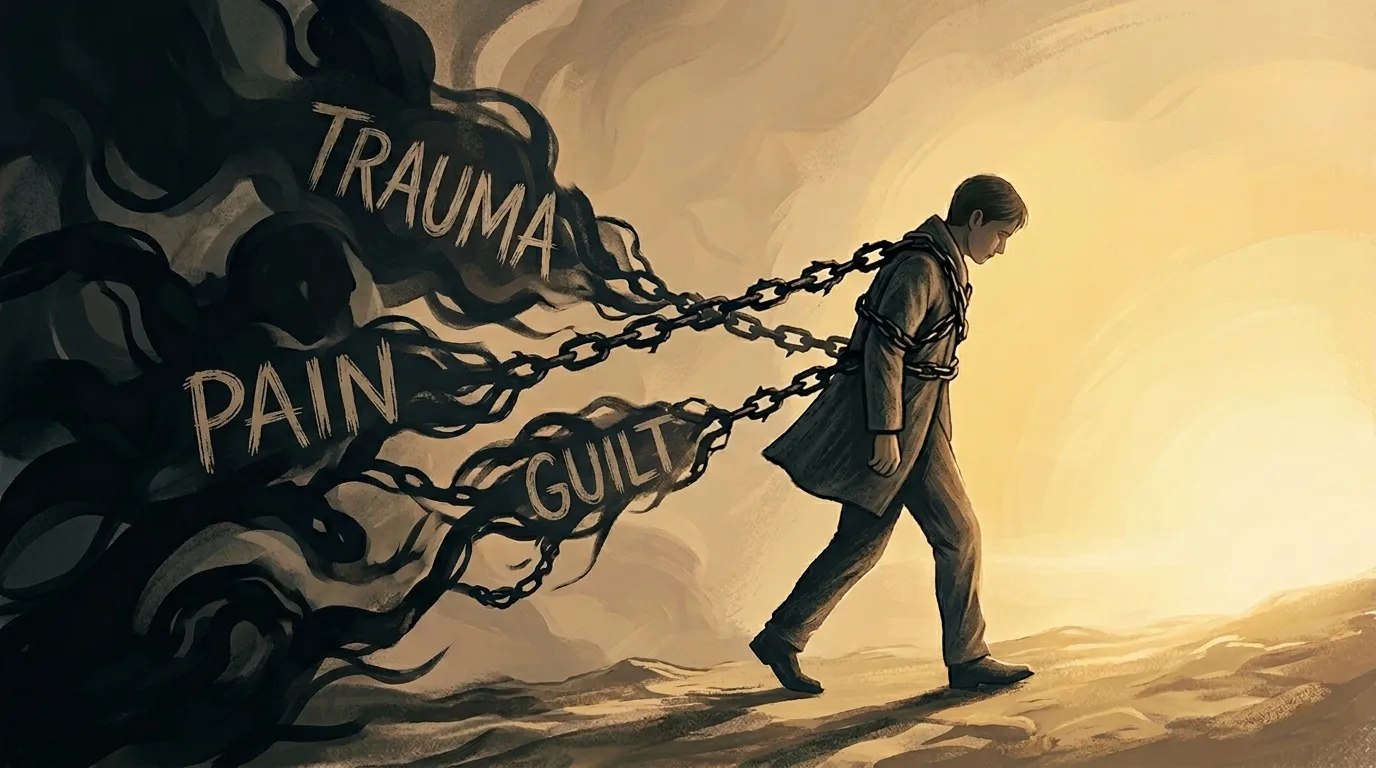
Today the debt is called trauma. You arrive in the world, or rather at the consultation room, already marked. Already at fault. Already needing to heal before you can live fully. The work is indefinite, the arrival criterion doesn’t exist, and if at some point you think you’re fine, there’s always a deeper layer to explore, some facilitator reminding you that the process is continuous and that the resistance to keep working is itself a signal that you need to keep working.
The architecture is identical. Only the names on the door have changed.
* * *
Healing is a beautiful word. What they’ve put inside it is something else.
People arrive with a concrete problem. Something is wrong and they want to know why and how to fix it. What they frequently receive is a theory about where that problem might come from, framed with enough vagueness to sound profound without committing to anything verifiable. And a sense that they’re on their way. To where, we’ll see.
That’s not healing. It’s the same promise of redemption as always, with different terminology and no cassock.