
The Mission
There’s a question that comes up with unsettling frequency. Sometimes in messages, sometimes in consultations, sometimes with a seriousness that’s almost painful to witness:
What is my mission?
And you could answer calmly. But something else is happening underneath. Because behind that question there’s no genuine search. There’s something far more human and far more uncomfortable: the need to be special.
That’s not a judgment. It’s an observation. And it deserves a proper look.
* * *
Living isn’t enough
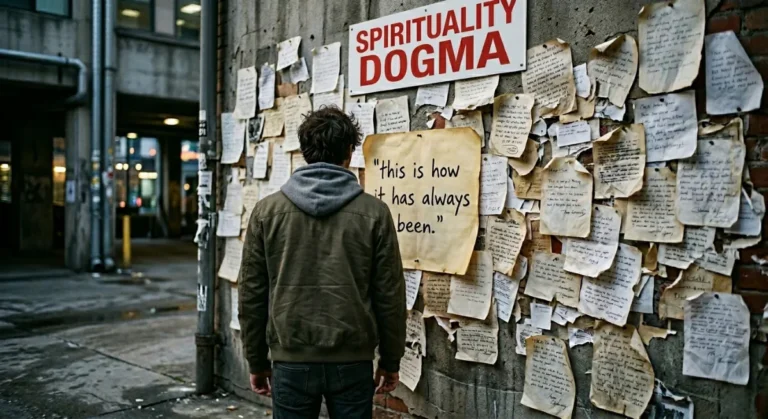
At some point, someone decided that life had to mean something specific. That it couldn’t just be that: life. Experience. Good days and bad days. Things you like and things you don’t. There had to be a prior purpose, a reason for being written somewhere before you were born, a mission that justifies your presence here.
And since that doesn’t seem like enough, the inevitable question follows: what am I here for?
The curious thing is that when you scratch the surface, that question isn’t looking for a philosophical answer. It’s looking for confirmation. That you’re not an ordinary human being. That there’s something in you that sets you apart. That your presence in this world isn’t accidental but necessary, important, unique.
Many teachers, the real ones, say the same thing: life is for living. For experiencing. That’s it. No extra weight.
But that’s not enough for the ego.
And here’s the paradox nobody mentions: if your mission were written in stone before you were born, what exactly would you be experiencing? What capacity would you have to create, to make mistakes, to choose? None. You’d be an actor following a script you didn’t write. Before asking what your mission is, you’d need to ask something much simpler: do you even know what you want? Do you have a direction, a desire, something that moves you? Because without that, there’s no mission to read. Not because it doesn’t exist, but because you haven’t lived it yet.
* * *
We can all be extraordinary
We live in a society that has spent decades repeating the same message through every available channel. Television, advertising, self-help books, coaches, famous people sharing their comeback stories. The message is always the same, just with different words: don’t settle for being just another face in the crowd. Stand out. Transcend. Leave your mark. If I made it, you can too.
It sounds good. What it hides underneath is something else: the idea that an ordinary life is a failure.
People use great figures as reference points. Artists, athletes, leaders, people with visible impact in the world. They watch them shine, and instead of being inspired to live better, they identify with them. I’m like them. I have that too, somewhere inside me. I just need to find my mission and everything will fall into place.
And that identification is always with the final image. With the visible result. Nobody sees the years before, the failures, the doubts, the moments when that person nearly gave up. You only see the artist on stage, the leader with followers, the teacher surrounded by people hanging on their every word. And from that image you build the fantasy that you have the same thing inside, waiting to be activated by the right mission.
But the mission doesn’t activate anything. It’s the other way around. First you do. Then, if you look back honestly, maybe you see something that resembles a direction.
* * *
Wait a moment
Someone is going to read this and say: wait, so wanting to be special is bad? Isn’t it valid to pursue success, to help people, to stand out at something?
Yes. Completely valid. And worth clarifying.
I’m not saying everyone needs to be grey and conformist. There are people who shine, who stand out, who have a real impact on the lives of others. That exists, it’s genuine, and it’s valuable.
The difference is in the origin.
One thing is something emerging from you naturally. Developing what you have, growing into what you’re good at, helping because you genuinely can and want to. That doesn’t need a cosmic mission beforehand. It simply happens.
Something completely different is building yourself an identity of being special before you know if you are. Needing a mission to justify your existence. Moving blindly toward something you can’t even name, because there has to be something more important than what you’re doing right now.
The problem isn’t wanting to be special. The problem is needing to be.
And that need has many faces. Some harmless, some dangerous, some frankly ridiculous. Here are the most common ones.
* * *
The bestiary
The lost ones
These are the most innocent of all, and also the easiest to spot.
They arrive with a mix of existential anxiety and hope that someone, something, a session, a reading, will finally tell them what to do with their life. They’ve spent years feeling out of place. They sense there’s something special inside them but don’t know what. And that generates enormous pressure: if they don’t find their mission, what’s the point of any of it?
Being lost is completely normal. What fails is the question they’re asking. Not what do I enjoy, what am I good at, what would I do if no one was watching. They ask what their mission is. As if life were a game with instructions assigned from the start and they’ve been stuck for hours without finding them.
It happens constantly. Someone comes in, tells you what they’re doing, which is generally fine, and at some point the sentence appears: surely you can tell me what my mission is. As if someone from the outside could know what only you can discover by living. They insist there has to be something different, something more important, something waiting for them somewhere. And when you turn the question back, when you ask what they want, what moves them, what they’d do if no one was watching, they go blank. Because they haven’t asked themselves. They’ve been too busy looking for the mission.
If you don’t know, and you’re the one living inside your own experience, how is anyone else supposed to?
* * *
The designated ones
This category has a long history behind it, and not all of it is pretty.
It works like this: someone, maybe a clairvoyant, a card reader, a therapist, the neighborhood witch, or simply someone who stops you in the street with a lot of confidence, drops something on them in a session or a conversation. I see a lot of light in you. You have a gift. I feel you have something important to do.
And that’s it. Everything changes from that moment on.
Shortly after, that person starts offering opinions on other people’s lives without being asked. They stop you in the shopping center to tell you what they’ve seen about you. They send a message saying they felt your energy last night and have something important to share. No warning, no invitation, convinced they have both the ability and the obligation to do it. Because they have a gift. Someone told them so.
What nobody says out loud is that there’s a chain of responsibility here. The one who designates and the one who believes it. And both are doing something that can have real consequences for real people.
The most dangerous one isn’t the person who believes it, but the one who designates without thinking about what they’re setting in motion. Telling someone they have a gift, that you saw something special in them, that they have a mission, is an intervention with real weight in their life. Doing it carelessly is a serious irresponsibility.
* * *
The self-proclaimed masters
They have one unmistakable trait: certainty. They don’t doubt. They don’t question. They don’t learn, because what would they learn when they already know everything?
They’ve been through a lot, they say. They’ve suffered greatly. And that suffering, pay attention, hasn’t been worked through. It’s been turned into a résumé.
The most striking thing is that their identity as a master works as a permanent shield. From up there they don’t answer to anyone. They’re never wrong. And if someone points out a contradiction, the problem is with the person pointing it out, who simply isn’t at the right level to understand.
The most illustrative case of the twentieth century has a name: Bhagwan Shree Rajneesh, later known as Osho. He started as a philosophy student in India, built an attractive discourse around meditation and liberation, and gathered followers who literally handed over everything they had. His central teaching revolved around freeing oneself from the bonds of ego and the material world.
The method to achieve this included dynamic meditation sessions where participants screamed, jumped, wept and thrashed about uncontrollably, combined with sexual relations with different people, ideally three times a day with rotating partners, all of it presented as a path to spiritual enlightenment. The master, meanwhile, lived secluded in his quarters and occasionally emerged to wave silently from his Rolls Royce. He had ninety-three of them.
When things got complicated in the United States, his community poisoned the food supply at several local restaurants to manipulate an election. The master of enlightenment, with a private army, a poison laboratory, and a fleet of luxury cars. His books are still in the spirituality section of any bookshop, with inspiring quotes on the cover.
* * *
Those who were someone important in a past life
This one deserves a moment of silence.
Because it’s striking that among the millions of people who have done past life regressions or readings, practically nobody turns out to have been an anonymous peasant from the fourteenth century. There’s always a connection to Cleopatra, a high-ranking Celtic druid, an Egyptian priest, Mary Magdalene, some warrior of noble lineage.
And of course, the powerful witch burned at the stake. That one comes up constantly. They all were one, without exception.
Nobody was the one who cleaned the stables. Nobody was the neighbor next door. Everyone was someone.
And that important past life justifies the present mission. I carry an ancient memory. I need to complete what I started back then.
Which raises a statistically uncomfortable question: if every era had a handful of greats and millions of anonymous people, where are all those anonymous souls reincarnated now? Have they all come back as people who don’t do regressions? Or do they just not fit the narrative?
* * *
The messiah complex
This is the most dangerous of all, and it needs to be said plainly.
It doesn’t always come with signs. In fact the most dangerous cases are the ones who don’t say it openly. They hint at it. They let it slip. They build a narrative of sacrifice and misunderstanding around themselves. Not everyone can understand me. I’m here for something that goes beyond what most people can see.
Psychologically it has a name and it’s well documented. The messiah complex combines narcissism with an enormous capacity for seduction. These people know how to read what others need to hear, give it to them precisely, and then build dependency on that.
The most grotesquely illustrative case is that of Hong Xiuquan, a young Chinese man from the nineteenth century whose origin story reads like a comedy. He was a student with modest ambitions: he wanted to enter the imperial civil service. He failed the entrance exam several times. After the last failure he had a nervous breakdown with visions that he interpreted as divine revelations. Conclusion: he was the younger brother of Jesus Christ, sent to eradicate evil from China.
He founded the Heavenly Kingdom of Great Peace. He gathered tens of thousands of followers. He unleashed a civil war that lasted fourteen years and caused between twenty and thirty million deaths, making it one of the bloodiest conflicts in history before the Second World War. When he started losing, he took his own life.
The younger brother of Jesus Christ. Who couldn’t defeat the imperial Chinese army.
It all started because he failed an exam.
This is the extreme. But the underlying mechanism, the absolute certainty of having a mission that justifies everything you do, works the same way at any scale. In any community, any group, any person convinced that what they’re doing is too important to be questioned.
* * *
The lightworkers
Before we get into this one, something needs to be said honestly: many of the people who adopt this label do so from a place of genuine loneliness. They feel disconnected, out of place in a world they don’t understand, looking for somewhere to belong. And this community offers them just that: belonging, identity, purpose. That’s real and it deserves respect.
What doesn’t deserve respect is what comes after.
Now everyone is a lightworker. Everyone works the light, radiates light, anchors the new light frequency into the Earth. The term became popular in the nineties and hasn’t stopped growing since. Today it’s almost impossible to move through certain circles without running into one.
But wait a moment.
What is light?
Don’t ask it as a trick question. Ask it seriously. Because if we go to the root, light in primordial terms isn’t simply the bright and the good. It’s the principle from which everything else derives. The origin. And as the total principle that it is, light has infinite facets, including those that aren’t particularly comfortable to look at. Shadow isn’t the opposite of light. It’s one of its consequences. One doesn’t exist without the other.
Which facet of light are you working from exactly? Have you actually explored it, or did you just stay with the one that felt most comfortable?
Because the lightworker most convinced of embodying the light is often the one who has asked themselves that question the least. And it shows. People who preach unconditional love and treat you with contempt if you don’t share their vision. People who talk about unity and exclude anyone who doesn’t vibrate at their frequency. It’s not simple hypocrisy. It’s what happens when someone puts on a label without understanding what’s behind it.
* * *
In case there’s still any doubt
History is full of people convinced they had a transcendent mission. Religious, political, historical. The form changes but the mechanism is the same.
Robespierre wanted to build a virtuous republic in France. He was so convinced he represented the will of the people that he governed the country with absolute certainty. The result was the Reign of Terror: between thirty-five and forty thousand dead in less than two years. When he was finally guillotined in the same square where he had ordered others executed, the crowd applauded for several minutes.
The savior of France. Guillotined by the people he had tried to save.
You don’t need to invoke any divinity to fall into this pattern. You just need to be sufficiently convinced that your mission matters more than any other consideration.
* * *
Life doesn’t need a prior mission to have meaning.
Meaning isn’t found before you live. It’s not written somewhere waiting to be discovered. It emerges while you live. Doing what you enjoy, what you’re good at, what comes from inside without anyone assigning it to you.
The people who have truly left their mark, the ones who really matter, didn’t start out declaring their mission. They started doing. Making mistakes. Learning. And at some point along the way, looking back, maybe they could see something that resembled a direction.
But first they lived.
Everything else is ego with better vocabulary.