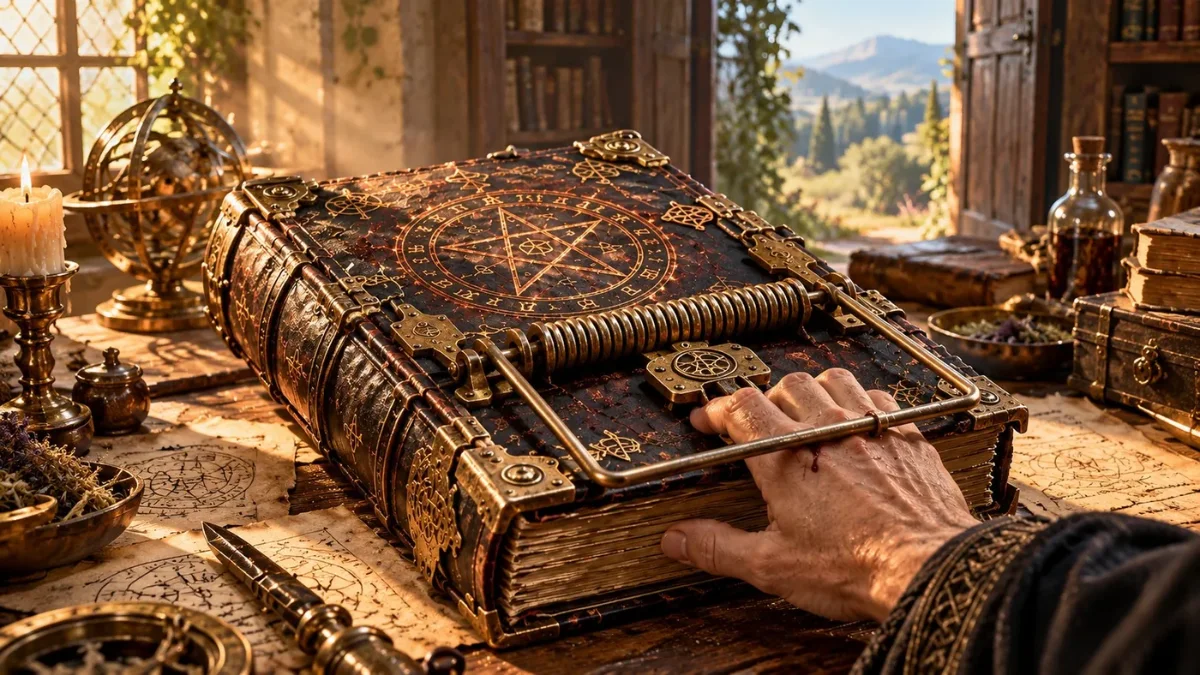
The Swiss Army knife that promises everything
The grimoire has become the Swiss Army knife of modern magic. Love? Such-and-such page, this seal. Money? There is a spirit for that, with its signature and its planetary hour. A neighbor hit by a sudden run of bad luck? That too. You open the book, find the right section, run the instructions and sit back to wait for results, like dropping a pod into a coffee machine.
Almost everyone who comes to this ends up looking at grimoires as if they were the wellspring the whole thing flows from. And a good chunk of people move in and stay, especially within the Solomonic strand, which for many is practically a synonym for "serious magic". Grimoire and Solomon are stuck together so tightly it is hard to pry them apart.
The word grimoire, by the way, gets slapped these days onto almost anything with a cover and some weird symbols. Strictly speaking it is a book of magic: a collection of spells, of tool preparations, of tables of correspondences, of conjurations for dealing with spirits. Sometimes it is barely more than a scrapbook, and sometimes it holds an entire system, with its rules, its timings and its closed way of working. Not every magical document fits in the same box. The Greek Magical Papyri, for instance, are a disorderly collection of formulas and procedures piled up over time, with no single method to follow. The grimoire tends to carry another air about it, that of a manual that knows what it is doing.
And like almost any book, it carries printed inside it the world of whoever wrote it.
* * *
A world split in two
The bulk of the Western canon, the Solomonic sort, was written from a very specific idea of how the cosmos is arranged. Up top, what the system embraces as divine, and there it places the angels and a certain class of spirits. Outside that circle, everything else, which becomes either dangerous or something to be forced into obedience. The magician works inside his circle, on the defensive, declaring an authority above him at every step in whose name he subdues the rest. It is one way of ordering the world. One among several. Not the world itself.
And here I should say where I am looking from, because I start from a specific idea of the divine: the force behind absolutely everything, the one that gives it cohesion. Every tradition names it in its own way and invents its own ways of dealing with it and with the forces it recognizes. In shamanism they call it the spirit, others give it other names, and none of them is off the mark. Working with a specific entity is perfectly legitimate, the same way you can know your neighborhood so well you could walk it blindfolded. The thing changes when you walk out of there convinced that your neighborhood is the whole map of the planet. Knowing one part well is not the same as having looked at the whole, and confusing the two is exactly where the system stops being a tool and turns into a fence.
The mess starts when that force stops being a force and turns into a guy with a name, a face and an enemies list. Because if everything is that same force, the enemy part does not add up. How can something that already contains everything, the supposed rival included, have a rival? The enemy was not in the cosmos. It shows up the moment you put a name on the limitless and cut it down to your size. The totality is one thing, and the shape and the limits each tradition draws around it are quite another. The funny part is that, as long as people talk about the totality, almost nobody argues. The fight starts the second each one pulls out his own label for it. And when you work from a post-Abrahamic system, one that comes with a God and his list of rivals already printed in, it is worth asking who you are really dealing with: the something that holds everything up, which cannot have enemies because everything is it, enemies included, or the label somebody stuck on top of it, grudges and all? How that line got drawn, and who it suited, I already dealt with in another article, so I will not repeat myself.
And let this be clear, because it is the heart of the whole thing: I am not coming after the Solomonic tradition. It shows up here because it is the thick trunk of the grimoires, not because I hold any grudge against it. The problem was never the system, but what happens when someone takes one, any of them, and turns it into the measure of everything. When it stops being a tool to look through and becomes the only window. From there on, what fits the frame exists, and what does not fit turns dangerous, false or invisible. It makes no difference whether the book is Solomonic, Islamic or Japanese. It makes no difference, in fact, whether it is a book of magic at all. It is the same move as the person who pulls out the Bible every five minutes to explain anything to you, as if nothing else had ever been written. The book is not to blame. The lens is.
Not even all grimoires split the world the same way. The Picatrix comes from another root, more astral, and plays by other rules. Which rounds the whole thing off: if within the grimoire family itself there are already different worldviews living side by side, taking a single one as the definitive map of reality is, to put it mildly, naive.
* * *
The trap has two faces
That a system is born on the defensive does not make it worthless. The grimoire works, and it works well within its own range. The problem is not in the book but in what people do with it, and there the trap shows up in two different shapes.
The first is the beginner's. Someone turns up full of enthusiasm, gets hold of a grimoire, and starts reciting. Draws the circle, lights whatever needs lighting, mangles the unpronounceable names with the confidence of a tourist ordering off a foreign menu, and repeats. Sometimes a result comes out, just enough to hook him. Plenty of other times nothing comes out, and then he decides magic is a fairy tale or that he is the one who is useless. What never crosses his mind is that he is handling a Swiss Army knife with every blade folded shut, convinced that just having it in his pocket is enough.
The second happens to people who know what they are doing, and that is what makes it more interesting. The serious, modern practitioner, who has mastered the technique, who has studied, who executes flawlessly. Over the years he sinks so deep into the system that he stops seeing it as a system. And he starts to believe, without quite saying it out loud, that the grimoire is magic, that outside those pages there is nothing worth respecting. Here the trap is no longer clumsiness. It is dogma, and it comes dressed up as rigor, which is the best disguise there is.
There is a technical point that shows nicely where this leads, and Agrippa already had it clear five hundred years ago. Each force has its jurisdiction. If the matter is a Mars matter, you talk to the martial, not to Jupiter, however grand Jupiter may be, because Jupiter does not rule in Mars's territory. And these errors of address happen more often than you would think. Using one system's tool for a goal that belongs to another is like calling the plumber to pull a tooth. He might come, he might do something, but that is not his pipework. And sometimes it does not stop at not working. Sometimes it goes straight to wrong.
* * *
So, what is magic?
If the grimoire is only a door, the question falls under its own weight: what is behind it. And the answer annoys anyone who came for a recipe, because magic does not fit in a table of contents.
Magic is dealing with forces. Relationship. Craft. It is something you do, not something you recite, and it depends far more on the state you show up in than on which paragraph you read. A magician with craft has built bonds, knows one by one the entities he works with, can tell when what reaches him is trustworthy and when he is being played. That does not get downloaded. It is cultivated, and it takes years.
The interesting thing is how many roads lead to the same place. I have seen magic done with a shoelace. With a candle and nothing else. With whatever happened to be on the table at the time. And it worked, because behind it was someone who already had his agreements made and his relationship established with whatever he was calling on. Traditional witchcraft works like that. Shamanism, whose forms come from much earlier and from another root, does too. And the Greek Magical Papyri themselves, that pile of recipes so many people revere as though it were a closed system. There is tremendously powerful magic that never once passed through a circle or a Hebrew name.
And all of that rests on something the grimoire takes for granted and never spells out: the preparation of the one doing the work. Ask yourself how you are going to command ten spirits when you have not yet learned to sit with one. The inner state you need to hold the current of energy you are asking for in a real evocation is not improvised on day one, the same way you do not walk into a gym and lift two hundred kilos because you watched the video. Franz Bardon, who was anything but loose, built his training in ten steps, and in his method you do not evoke anyone until you have mastered at least the first eight, concentration, breathing and inner balance included, on pain of genuinely hurting yourself. The most systematic man of all put eight rungs before the first spirit. There would be a reason for that.
* * *
The grimoire is a door, not the house
Since we came in through the book, let us leave through it too, only looking at it with other eyes.
The grimoire is useful. It gives you a frame, and a frame well used gives focus, lets you aim at a single point all the power you have been gathering over the years. I work with them and I have no intention of letting them go. What they are not is the end of the road, far less the whole road. For a lot of people they are a good way in, though not even the only one. The mistake is settling down to live in the entrance hall convinced that this is the whole house, and defending it on top of that, because the book says so, so the book says so. The same stubbornness as the person who has read a single book and is convinced he has read them all.
Question it. Ask yourself why things are done this way, and pay special attention to the points where the answer comes up short, where habit turned into rule without anyone revising it, or where a gesture that once made sense ended up as dogma. Magic is far wider than any collection of seals and conjurations. The grimoire opens a door, and it is well worth stepping through. But behind it there is an enormous house, with many more rooms, and some of its doors do not even need a key.
This is a personal conclusion, from quite a few years of dealing with shamanism, magic and everything that comes with them. It is not a whim or a shower thought: it is the point where my own experience meets the work of other magicians and of people who have worn their eyes out researching this stuff. I have not filled the text with citations because I did not want doorstop, but none of what I say is pulled out of thin air.