When someone first wanders into spirit work, they almost always show up with the same question nagging at them: what exactly am I dealing with here? And they show up with two pictures already drawn in their head. A more or less clear idea of what an angel is, and a much more loaded idea of what a demon is. The angel has white wings and good intentions. The demon has horns and an appetite for harm. And sitting right between those two catechism drawings is the Goetia, that list of seventy-two "demons" everyone has seen floating around online, complete with sigils and unpronounceable names.
This article is about taking most of that apart. Not because I enjoy being contrary, but because when you work with these forces for years and then actually bother to read where they came from, you find out that the story we've been told has more in common with a marketing campaign than with reality.
Let's take it piece by piece, because there's plenty to get through.
* * *
What is the Goetia?
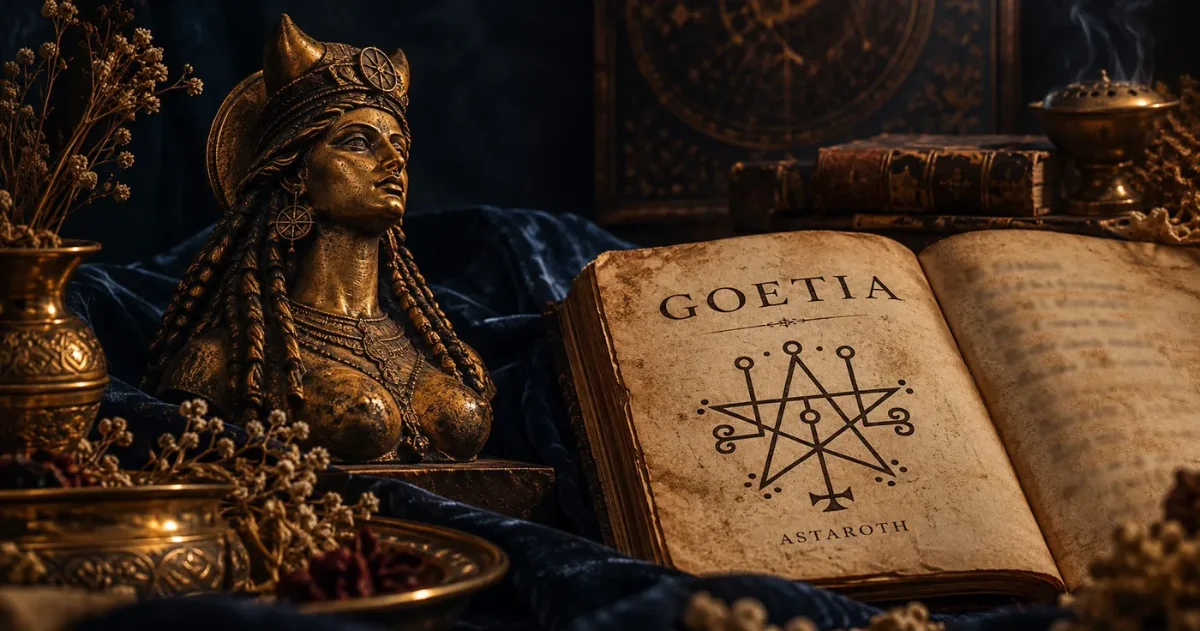
The Goetia is, first of all, a catalog. A list. Specifically the Ars Goetia, the opening section of a seventeenth-century grimoire called the Lemegeton, or Lesser Key of Solomon. It names seventy-two spirits, each with a rank (kings, dukes, princes, marquises, counts, presidents), a sigil, and a short note on what it does or teaches.
First thing worth knowing: seventy-two isn't a sacred number somebody received in a vision. It's a number of convenience. It matches the Shem haMephorash, the so-called "name of seventy-two letters" that Kabbalah draws out of three verses in Exodus, which in turn yields seventy-two angels. At some point somebody decided that if there were seventy-two angels, there had better be seventy-two spirits on the other side to keep the books balanced. Accountant's symmetry.
So the Goetia isn't the complete census of anything. It's a late slice of a much older and much wider tradition, trimmed to a round number so it would look tidy. The spirits in it existed, under other names and in other settings, long before anyone filed them into that list. And there are thousands more that never made the cut.
Second thing: these seventy-two get called "demons." And that's where the misunderstanding starts.
* * *
What is a demon?
The word "demon" comes from the Greek daimon. And a daimon, originally, was nothing bad. Quite the opposite.
Socrates had a daimonion. Plato tells us so. It was a kind of inner voice that had been with him since childhood, and its job was to warn him when he was about to make a mistake. Not a tempting little devil: a guiding spirit, an intelligence with a character of its own, operating on another plane and making contact with ours. The root of the word has to do with "dividing, distributing": the daimon was the one who handed out destinies, the lot you were given. A lesser deity, a divine power. Nothing to do with horns or brimstone.
So how did we get from "guiding spirit with good manners" to "henchman of Satan who wants your soul"? It wasn't by accident. It was by translation. And by decision.
When the Jewish translators of Alexandria rendered the Hebrew scriptures into Greek (the Septuagint, third century BC), they ran into words that named the gods of neighboring peoples. And they translated them as daimonia. In a psalm where the original Hebrew says elilim (worthless idols, a jab at other people's gods), the Greek says daimonia. From then on, every time a god showed up who wasn't the correct god, the word chosen to name it already carried the full weight of the dangerous and the impure. Paul sealed the deal in practice: worshiping any god that isn't ours amounts to worshiping a demon. And a few centuries later, the Christian theologians closed the circle by declaring that daimones were evil, no exceptions.
In under five hundred years, a word that meant "divine spirit with a character of its own" came to mean "evil." Not because the entities changed. Because the power to name them changed hands.
And this is worth stopping on for a second, because "demon" today gets used to cram together things that have nothing to do with each other. When someone says "demon," they could be talking about at least three different things.
One: a spirit or deity whose function is destruction. This is what serious magic calls a demon without the word implying evil. They're forces that destroy, yes, but destroying isn't the same as being bad. Fire destroys. A storm destroys. A flood destroys. We don't call fire evil for it. They're forces that move energy, that bring balance back, that sustain cycles of creation and destruction on a scale where the human category of "harm" simply doesn't apply. They run on their own rules, not ours.
Two: a parasite. This is something else entirely, and it's what actually shows up in exorcism movies. Entities that look for an empty vessel or a weakened system, slip in, feed on energy (fear, pain, pleasure, obsession), and disguise themselves as whatever you expect to see. If you expect an angel, you get an angel. If you expect an alien, an alien. These do "possess," these do real and direct harm, and they have absolutely nothing to do with the old gods of the goetic catalog. A parasite isn't a fallen deity. It's a hungry bug.
Three: a degraded egregore. The group mind of a religion, a lodge, or a system that's been parasitized and starts moving its members around like chess pieces. But that's a subject for another day.
The point: when we talk about the spirits of the Goetia, we're talking mostly about the first kind. Forces with character, with function, many of them ancient deities with a distinguished past. Not the second kind, not the third. Dumping all three in the same bag and calling them all "evil demons" is like calling a bear, a tick, and an angry mob all "dangerous animals." Technically all three can hurt you. But confusing them means you haven't understood a thing.
* * *
The fallen angel story
While we're at it, we have to take down one of the most stubborn ideas of all: the demon as fallen angel. Everyone knows the story. Lucifer was the finest of the angels, his ego got the better of him, he rebelled against God, lost the heavenly war, and fell, turned into the devil, dragging a third of the host down with him. Dramatic, tidy, perfect for a blockbuster.
The trouble is it barely holds up anywhere.
For starters, Lucifer doesn't appear in the Bible. Or more precisely: the word appears, but it doesn't name who everyone thinks. In the Hebrew of Isaiah 14:12 you read Helel ben Shachar, "the shining star, son of the dawn." It's a metaphor for the planet Venus as the morning star, inside a taunt aimed at a king of Babylon. Politics, not cosmology. When Jerome translated the Bible into Latin in the fourth century, he turned helel into lucifer, which in Latin was simply the name of the morning star, the same word used in the Easter liturgy to refer to Christ. What turned that political verse into the biography of the prince of hell was a chain of later reinterpretations that hung a tale of celestial downfall on a text that never mentions one.
And the very idea that an angel who disobeys automatically turns into evil comes mainly from the Book of Enoch, a text that Judaism itself eventually left out of the canon because it didn't square with what it stood for. It isn't scripture. It's literature some used and others threw out.
There's a detail the eternal-war narrative blithely ignores: in the ancient texts, angels and demons don't fight each other. In the Book of Daniel, an angel spends twenty-one days battling the "prince of Persia" and needs backup. There's no demon in that scene. There are divine beings assigned to different nations with clashing interests over the same territory. Celestial geopolitics. And the "Satan" of the Old Testament isn't the leader of a rival faction: in the Book of Job he sits in the divine council, alongside the other sons of God. He's the prosecutor, the accuser. A post inside the system, not an enemy outside it.
And the image of the archangel Michael trampling the defeated demon, sword raised? It isn't ancient. It's Baroque. It was born in the sixteenth and seventeenth centuries to represent one very specific thing: the triumph of militant Catholicism over heresy. Counter-Reformation propaganda that got installed as if it were truth from time immemorial.
What the fallen-angel story describes isn't a cosmic event. It's a very simple control mechanism: whoever steps outside the system, by definition, becomes evil. They didn't fall. They were reclassified.
* * *
So where's the darkness?
Here we arrive at one of the most repeated bits of nonsense in modern occultism: the idea that these spirits belong to the "dark side," to the "left-hand path," to the infernal understood as murky and sinister. And the logic behind it is astonishingly lazy: since they're the opposite of the angelic, and the angelic is light, this has to be darkness. Playground syllogism.
Except it doesn't work that way. The distinction the honest traditions describe isn't light against dark or good against evil. It has more to do with the domain each force operates in. Angels are a force that operates outside the earthly sphere: cosmic, cold, executive, alien to the human. The rest of the spirits are far more tied to the Earth and the underworld, to the world below. It isn't a moral hierarchy, it's a question of where each one acts. Each force governs a different part of creation, each in its own ground, with its own function and nature. Some people map it with the old language of what sits above and below the Moon, and that's not a bad way to picture it, but the map matters less than the idea underneath it: not good versus evil, but each force at its own altitude.
And there's a fine irony in all this. The people who work with angels for real, seriously, find themselves dealing with icy entities. No personal preferences, no human warmth, executors of specific forces. They carry out tasks. Full stop. The "demons," by contrast, are paradoxically the ones most like us: they have personality, they have preferences, they have pragmatism, you can build a relationship with them that runs from cooperation to friction. They're more geological than moral, like fire or a storm: devastating if you don't understand their nature, extraordinarily useful if you work with it.
So "infernal equals dark equals evil" is a chain of inherited prejudice, not a description of anything real. Evil is a concept of ours, a human lens that works beautifully for navigating daily life and is completely useless for describing what's on the other side. What looks like opposition from here is, from higher up, complement.
And since we're on the subject of who the villain is: it turns out that a good chunk of the rites run by "the good guys," the respectable religions, the luminous ones, are pure coercion. Orders, threats, conjurations to force the spirit to obey under pain of divine punishment. Read the classic formulas of exorcism and conjuration and they're packed with "I command you," "I constrain you," "by the power of so-and-so I compel you to." In other words: they painted demons as coercive, controlling beings while writing the most exhaustive manuals of coercion and control in history. The one doing the accusing usually knows the crime best.
* * *
Hierarchies, or the art of ordering what won't be ordered
You'd expect that at least the structure of all this would be solid. That there'd be a clear org chart of the underworld with its kings, its dukes, and its chains of command properly nailed down. Nope.
Anyone who has studied the grimoires seriously knows that the hierarchies reach us in a remarkably fluid and arbitrary state. There is, yes, a skeleton that keeps recurring: three supreme chiefs at the top (depending on the version, Lucifer, Beelzebub, and Satan, or else Lucifer, Beelzebub, and Astaroth), and below them four Kings tied to the four cardinal points and the four winds. That scheme wasn't invented by some medieval grimoire-writer: it's inherited from Late Antiquity, from Egyptian and Syrian ideas about the stations of the Sun and the winds. Everything else, the names, the ranks, the assignments, dances from one text to the next.
And when you get down into the detail, it borders on comedy. In some manuscripts, between the great spirits and the rank and file, you find whole layers of "messengers" whose only documented function seems to be talking to other messengers. Bureaucrats of the abyss passing memos. An infernal multiplication of middle-management posts that some overzealous copyist probably tacked on, the same way a company keeps inventing deputy vice-presidencies attached to the sub-directorate of the coordination department. If hell is as hierarchical as they paint it, at least it had the decency to look like a government office.
The serious point behind the joke matters: the "official" order of the demons isn't a revealed truth. It's a late invention, variable and fairly arbitrary, laid over a much older tradition where what counted were the forces, not the org charts.
* * *
Where these spirits really come from
Up to here it's all been demolition. But under the rubble there's something, and it's quite a bit lovelier than what was sitting on top. Strip away the layers of propaganda, of bad translation, of administered fear, and what's left is this: many of these "demons" were gods. Deities whole peoples prayed to, made offerings to, and asked for help, for centuries.
The clearest and best-documented case is Astaroth. Astaroth is Astarte. The great Semitic goddess of love and war, worshiped across the Levant, the same one who in other places and tongues was Ishtar, Inanna, Asherah, and whom the Greeks ended up folding into Aphrodite. A major deity, first rank. Her name was deformed: the Hebrew form Ashtoreth is read, on the interpretation most scholars accept, by slipping the vowels of boshet, "shame," into the original name, so that whoever pronounced it was literally naming disgrace. They changed her vowels, changed her gender (from goddess to male demon), and shipped her off to the list of dukes of hell. (Honesty requires a note: not every author accepts the connection; some modern occultists hold that the demon Astaroth and the goddess have nothing to do with each other. But the weight of scholarship is on the side of the identification.)
Bael is another case. The Bael of the grimoires is reasonably identified with Baal, the great storm god of the Canaanites and Phoenicians, the lead figure in the Ugarit mythological cycles. Not a shadowy being: a first-division heroic deity who lost the culture war and ended up as a catalog entry. (Here a little more caution is in order than with Astaroth: the identification is widely accepted and very reasonable, but it rests more on logic and the likeness of the name than on a closed documentary chain.)
And there's a third case I'm especially fond of, because this time the trick wasn't pulled by an ancient translator but by Hollywood. Pazuzu. Anyone who has seen The Exorcist knows him as the being who possesses the girl, the embodiment of absolute horror. Well: Pazuzu was, in Assyrian and Babylonian Mesopotamia, a wind spirit with exactly the opposite function. He was a protector. People hung amulets of his head in their homes and around the necks of pregnant women to ward off Lamashtu, the entity that threatened newborns. He was invoked to defend, not to attack. William Friedkin picked his image for a 1973 film, and ever since, for millions of people, Pazuzu is the demon par excellence. The same mechanism that turned Astarte into a duke of hell, run again, only this time with a camera and a soundtrack instead of swapped-out vowels.
And then there's the whole line connecting the goetic spirits to the chthonic daimones of the Greco-Roman world: the intelligences of the underworld, the entities of classical necromancy, the forces the Greek magical papyri worked with. Goetia, before it was a list of demons in a seventeenth-century grimoire, was a continuous tradition of dealing with the spirits of the underworld that reaches back to Greece and further. The catalog is the final photograph of something that had been filming long before anyone thought to take the picture.
A warning before we go on, because this calls for care. That a goetic spirit has an ancient deity behind it doesn't mean there's a clean, one-to-one table of equivalences for all seventy-two. There isn't. Some identifications are solid and well supported (Astaroth, Bael). Others are reasonable. And plenty of the ones circulating on forums are pure wishful thinking: somebody read two things and decided that such-and-such goetic spirit "is" such-and-such Egyptian god because it sounded similar. Not every great ancient spirit has a direct heir in the catalog, and forcing correspondences that don't exist is exactly the kind of mental fluff this article is trying to clear out. Better three firm equivalences than thirty invented ones.
* * *
The same trick, on both sides of the Atlantic
Which brings us to a question I get often: what about the Afro-American traditions? Aren't the goetic spirits present in Voodoo, in Santería, in Hoodoo? That idea gets around a lot, and it has its logic: if these spirits turn up across half the planet under different names, why wouldn't they be there too.
So let's follow that thread and see where it goes. Because it goes somewhere, just not where you'd expect.
Hoodoo, to begin with, isn't even a religion: it's a system of practical African-American magic, born from the mixing of African traditions, Protestantism, and the Bible under the conditions of slavery and Jim Crow. And in Hoodoo the demons aren't allies, they're enemies. The spirits worked with are ancestors, angels, saints, the Holy Spirit. The Goetia, with its circle and its conjurations of infernal spirits, simply never got in. Seals, psalms, and divine names were borrowed from some grimoires, but the goetic catalog stayed outside.
Santería (Yoruba-rooted) and Haitian Voodoo (Fon-rooted) are religions, with their own complete pantheons: the orishas, the lwa. They aren't catalogs of relabeled European demons. They're whole, self-contained systems, with their own cosmology and their own deities. Looking for the seventy-two of the Goetia in there is like looking for Spanish league players on a Japanese baseball team: you'll find parallels in the game, but it isn't the same roster.
And yet there is a real connection, and it's far more interesting than a list of shared names. Because when the Yoruba slaves reached the Americas and the Church forbade them their gods, they hid those gods behind Catholic saints so they could keep worshiping them. And one of those gods, Exu, the orisha of the crossroads, messenger, trickster, lord of the roads, they syncretized directly with Satan. With the devil.
It wasn't some folk mix-up. It was missionary work: the first Yoruba vocabulary compiled by a Christian missionary, in the mid-nineteenth century, already translates Exu as "the devil." With a name attached and a date attached. And the question is the same as always: why did Exu end up turned into the devil? Not because he was evil. Because he was a spirit of the crossroads, powerful, with an agenda of his own, who didn't fit into the Christian system. Exactly the same reason Astarte became Astaroth and Baal became Bael. A god of another people, reclassified as a demon for the crime of belonging to another system.
There's the real connection. It isn't that the goetic spirits "are" in Santería. It's that the same demonizing mechanism that recycled the gods of the ancient Mediterranean fired up again, centuries later, with the gods of Africa. On one side of the Atlantic they turned a goddess of love into a duke of hell. On the other, a god of the roads into the devil. And in both cases the deity's sin was the same: existing outside the one permitted system.
There's more, and here I'm stepping onto ground where I can't make claims, only ask. That same Exu is the same force under three names across the width of the Atlantic: Exu in Brazilian Candomblé, Eleggua in Cuban Santería, Legba in Haitian Voodoo. Same African origin, a single spirit that traveled and put down roots under different names depending on where it made landfall. That much is documented. What isn't documented, and so I'll leave it as a question and not an answer, is whether that force of the crossroads, quick to deliver, tied to the roads and to dealings with the dead, is also the same one that turns up in other, farther-off pantheons under other faces. It's tempting to think so. The pattern invites it. But a historical thread you can follow is one thing and a hunch is another, and I'm not going to sell you the second as if it were the first. I'll leave it where it stands: as an open possibility that someone who works with these forces may recognize, and that nobody, myself included, can prove on paper.
* * *
In short
The beings that exist are the ones that always existed. They were here before the mistranslated psalm, before the theologian who closed the argument, before the catalogs of seventy-two and the lists of guardian angels, before the horror movies. What changed wasn't their nature. What changed was who held the power to name them, and what they got out of it.
The Goetia is a late slice of an age-old tradition. Its spirits were called demons because the word, which once meant "divine power," had been hijacked and dyed with brimstone. Many of them were gods. The split between the luminous and the dark doesn't describe reality: it describes who wanted to control access to it. And the mechanism that demonized Astarte is the same one that, centuries later, demonized Exu.
So you might be working with the Goetia without knowing it. Or you might, when you think you're dealing with a demon, have in front of you a very old god who had the bad luck to land on the losing side of a war that was never his. You're the one lighting the candle. Who you light it with is another conversation.
This article is based on my own research over many years, cross-checked against reliable sources: serious authors of the contemporary magical tradition, academic work in the history of religions and in linguistics, and the manuscripts and grimoires of the tradition itself. I chose not to load the text with citations and footnotes so it wouldn't turn dense, but every historical claim that appears here is documented and verified. What doesn't hold up against sources, I left out. And what's my own interpretation, I hope reads as exactly that.